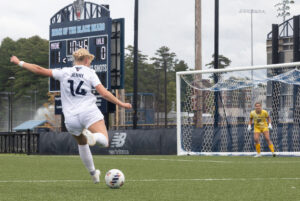
On Thursday, Aug. 20, the University of Georgia women’s soccer team set the NCAA attendance record for a men’s or women’s soccer match, drawing 25,433 fans. The “Soccer at Sanford Stadium” game was hosted in honor of the 30th anniversary of the United States Women’s National Team 1996 Olympic gold medal. The night was a monumental moment because it showed that women’s sports have an audience and can generate large crowds.
For Georgia, the match provided an opportunity to showcase women’s soccer in one of the largest venues in college athletics that is usually reserved for football. The 25,433 fans smashed both the previous NCAA women’s attendance record of 14,410 set in 1999 between Notre Dame and the University of North Carolina and surpassed the men’s record of 22,512 set in 1980 between Saint Louis University and Southern Illinois University-Edwardsville. The stadium was filled not only with Georgia fans but also with people who wanted to be part of women’s soccer history. The size of the crowd transformed the atmosphere inside the packed stadium and the noise within made the event feel bigger than an ordinary out-of-conference game.
The significance becomes even clearer when put into the perspective that UGA’s soccer team traditionally plays home games at Turner Soccer Complex, which seats about 1,700. According to U.S. Soccer, it only took one game into the 2026 season for Georgia to surpass their home attendance record total from last season, which was 15,916 in 12 games.
One of the fans who was a part of this historic night, Rosanna Ames, said how much it meant to her as a mother who has been around the soccer community for years supporting her daughter.
“To be able to see the girls play in that stadium was pretty cool,” said Ames. “Because it was a free event and promoted well, a lot of kids got to see the inside of the stadium that they never have before.”
While the crowd provided the biggest headline of the night, Georgia also used the energy of the stadium to their advantage as they defeated James Madison University 6-0. Two of those goals came from fourth–year midfielder Honoka Hamano, who played a major role in making history.
“It was just so cool to be there and I looked up at the stadium and saw so many people supporting us,” said Hamano. “It felt like we were representing women’s soccer and it depends on us.”
There was additional significance to this night as Sanford Stadium has a long history with women’s soccer. 30 years earlier, the stadium hosted the 1996 Olympic women’s soccer final where the USWNT defeated China in front of a crowd of 76,489. This was the first year that women’s soccer became an Olympic medal sport and placed it on one of the world’s biggest athletic stages. This final represented an important moment in establishing women’s soccer on the international stage, and 30 years later, it demonstrated the ability of the college game to generate interest. The same stadium that witnessed the emergence of women’s soccer as an Olympic sport now witnessed another landmark in its growth.
The event was a major win for collegiate soccer and demonstrated that women’s sports can attract a massive audience when it is given a venue, extensive promotion, and a compelling story. Sanford Stadium became a symbol of the growing visibility and a milestone of what is possible for women’s sports moving forward.