OPINION: You might think the most striking thing about Iceland would be the cold. After all, it is located in the subarctic. However, I’ve found the temperature to be one of the least notable things about this country of surprises.
In fact, my second thought upon leaving the Keflavík International Airport was that it wasn’t as cold as I was expecting. My first thought was that it smelled like the ocean. Those thoughts aren’t as disconnected as they might appear given that Iceland is kept relatively warm by the Atlantic Meridional Overturning Circulation, which carries warm ocean water from the tropics to Iceland. From 1981 to 2010, Iceland’s average annual temperature was about 43 degrees fahrenheit on the south coast and 37 degrees fahrenheit on the north coast.
I quickly learned that Iceland does have formidable weather. I remember a particularly challenging walk to school in the Westfjords during which I had to stop and plant my feet to avoid being pushed over by the wind. In Iceland, a strong wind at the wrong angle can rip an open car door off. At times, snow blows across the roads like desert sand.
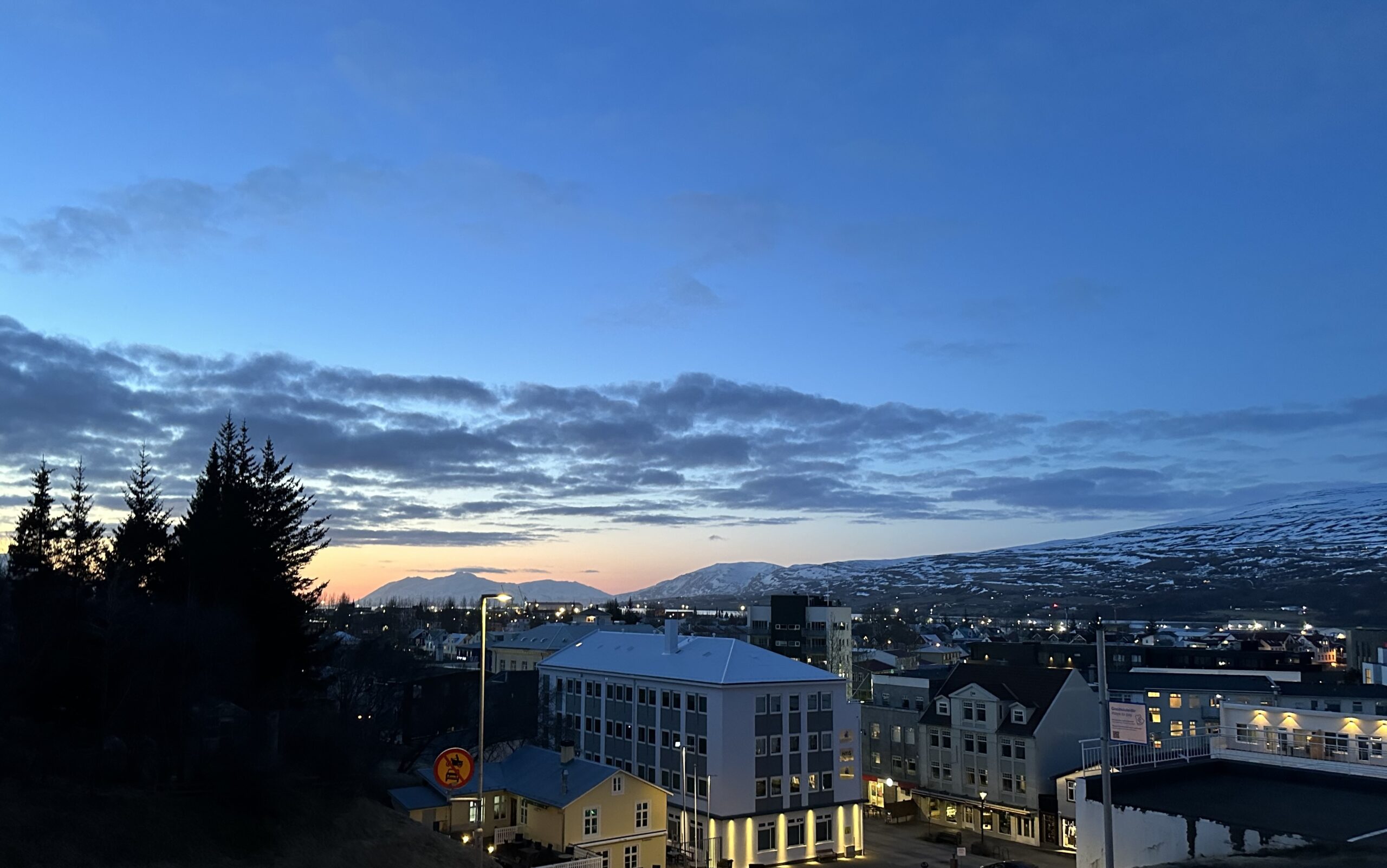
There are several reasons why Iceland is so windy. The first is that Iceland is near an area of low pressure in the North Atlantic. Second, Iceland’s mountainous topography impacts local winds. However, coming from Maine, what stood out to me was the lack of trees to break the wind. Iceland is about 2% forested. By contrast, Maine is about 90% forested. Iceland and Maine are both sparsely populated, but they feel very different. Rather than driving through forests from which towns emerge, towns are tucked between mountains. When you look at the landscape, there are almost always mountains on the horizon.
For me, the biggest surprise was Iceland’s geothermal water. Iceland is located on the Mid-Atlantic Ridge, which means it has a lot of volcanic activity. One result is that hot water flows under the ground. This water is harnessed in many ways, my favorite being the public pools, found in almost every town I’ve visited. Unlike in Maine, these outdoor pools are open all year round because the water is very warm. Every one I’ve seen has hot tubs at different temperatures. Some even had water slides and a sauna. There is nothing that quite compares to relaxing in hot water during a snow storm.
By far the most challenging thing to adjust to has been the light. My relationship with the sun has changed drastically while being here. I thought I was prepared. After all, I grew up in Maine. I’m used to missing the sun. By the time I arrived in Iceland, the darkest days of the year were over and the sun set after 5 p.m. I was caught off guard when the sun didn’t rise until 10 a.m. During my first week, I would start my day in what looked like the middle of the night, and it stayed that way for a few hours. The light changes very quickly here. A week later, I walked to school at 8:40 a.m. and watched the sun begin to rise.
Now that it’s April, the sun sets after 9 p.m. In my early days here, people told me how challenging it is to maintain a normal routine when the sun barely sets. I didn’t believe them. Now, though, I realize how much my sense of time is tied to the light outside. I can only imagine what the next month will feel like. It will certainly be a surprise.