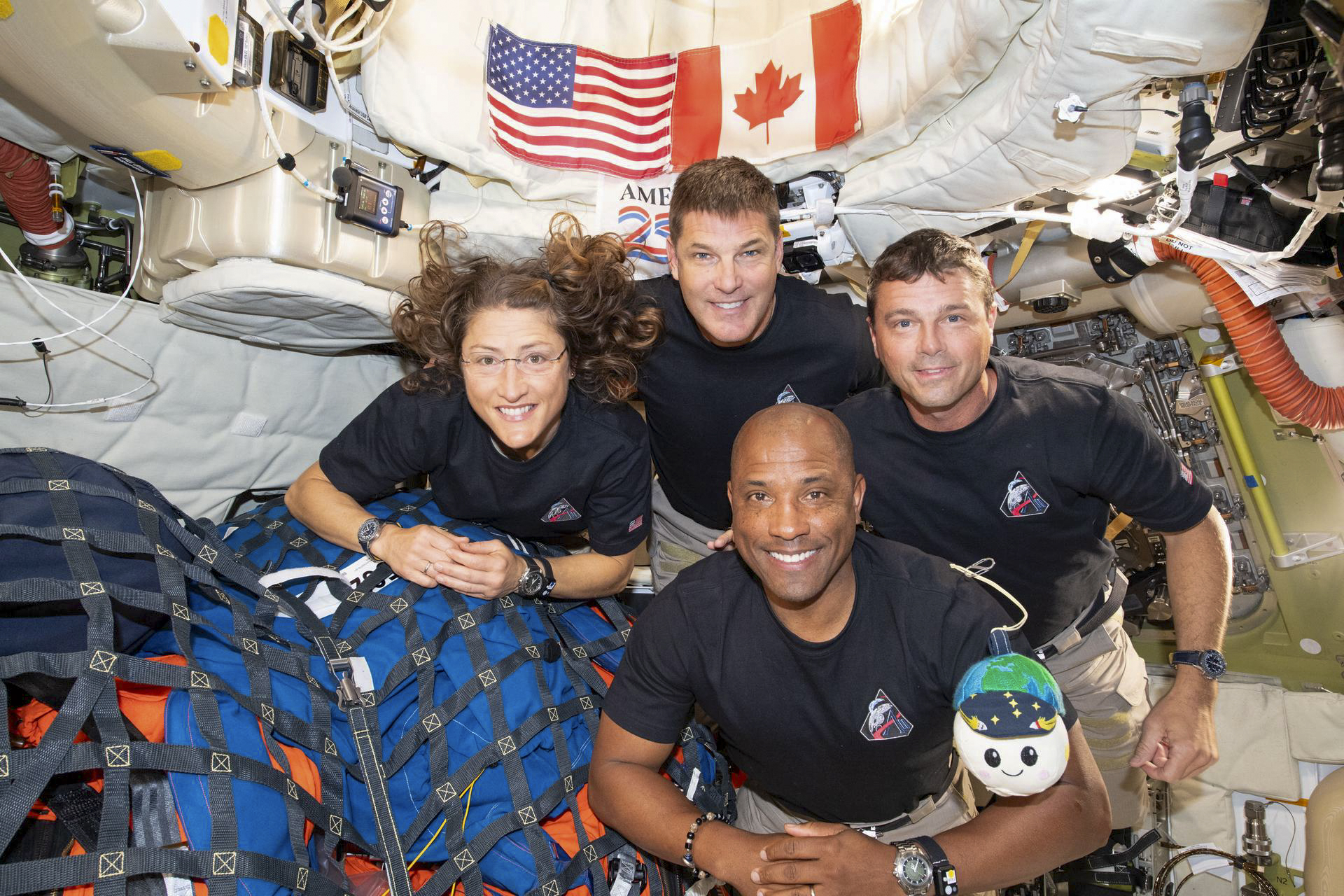
OPINION: On Friday, April 10, the Artemis II returned to Earth by landing in the Pacific Ocean off the coast of San Diego, signifying a massive win for America. Launched on April 1, the Artemis II team was sent to test a multitude of different factors as this lunar flyby was the first human return to the moon’s vicinity in over 50 years. However, the mission was particularly focused on testing the Orion spacecraft’s life support systems as space travel is increasingly becoming longer in duration.
The crew sent out for research was composed of four astronauts: Commander Reid Wiseman (NASA), Pilot Victor Glover (NASA), Mission Specialist Christina Koch (NASA) and Mission Specialist Jeremy Hansen (Canadian Space Agency).
As planetary explains, “During the mission, the Artemis II crew tested Orion’s various capabilities in deep space. That includes life-support and environmental systems, manual piloting and proximity operations and communications and navigation systems. The crew also contributed to studies of human physiology, sleep, motion and other biological responses to space travel. … the crew also made geological observations that could help scientists refine planning for the Artemis III mission.”
This is actually a really big deal. The United States hasn’t been to the moon’s general vicinity since 1972 during the Apollo missions. The last time we sent people to the moon, the world wide web had not even come into existence. So many global developments have taken place in the world since the Apollo missions. As a society, we’ve been able to create automated cars, cellphones, launch the Hubble Space Telescope, create crypto currency, etc. The technology we as a society possess today is far superior to anything they had 50 years ago. That being said, until recently we haven’t even attempted to go back.
In part, the urgency regarding space exploration in the 1970s, commonly known as the space race, was caused by geopolitical uncertainty during the Cold War. Since its conclusion, governments haven’t been as concerned with colonizing the moon.
While global tensions certainly aren’t as hot as they were during the Cold War and the space race, these new Artemis missions have in a sense reignited the competition. However, unlike the first time, the competition isn’t Russia: this time it’s China.
As CBC explains, “NASA’s Artemis program has drawn attention for its plan to send astronauts around the moon. But behind that mission is a broader strategic push: a new race between the United States and China to return humans to the lunar surface. This time, the race is about more than flags and footprints. The country that gets there first could gain an advantage in choosing where to build future lunar infrastructure, setting technical standards and shaping the next phase of space exploration.”
Things are really starting to intensify as both countries are making new moon landing predictions with China’s chief designer of their lunar program, Wu Weiren, even saying to CBC, “By 2030, the Chinese people will definitely be able to set foot on the moon. That’s not a problem.”
NASA has pledged to get feet back on lunar soil in 2028, but the threat of China still remains. As Dean Cheng, a senior fellow with the Potomac Institute for policy studies, explained to CBC “One of the striking things about the Chinese space program has been that they don’t make too many predictions,” Cheng said. “But the ones that they do, they absolutely fulfill.”
If the United States and NASA don’t hit their 2028 predictions, the race to colonize the moon gets a lot closer than people may think. This may not sound very important however this time the stakes are significantly higher than ever before.
We now have access to technology that can actually sustain life on a different planet. These trips aren’t just to stick a flag in the ground, it’s about sticking people on the ground (to live) and the first country to successfully do so will reap all the benefits.
Recently it has been determined that there could still be ice at the south pole of the moon. This realization is extremely important as Casey Dreier, Chief of Space Policy at the Planetary Society, explained to CBC, “Which just means it’s cold enough that you can trap water and ice over billions of years,” he said. “You take water, you separate the two molecules, you can make rocket fuel. We can breathe oxygen, you can drink it.”
This new space race is developing fast. Both parties are gearing up to colonize the moon and now the question becomes: who will get their first?