This story was originally published on Oct. 2, 2026, by The Free Press and has been republished through the UMS Exchange student media partnership.
On Sept. 21, many University of Southern Maine students received a text message that read, “Hi, this is PAWS, USM’s AI student assistant. USM recently invited you to complete a check-in. Reply with a question, concern, or a few words about how your semester is going. If you’d rather speak with a person, just say so.
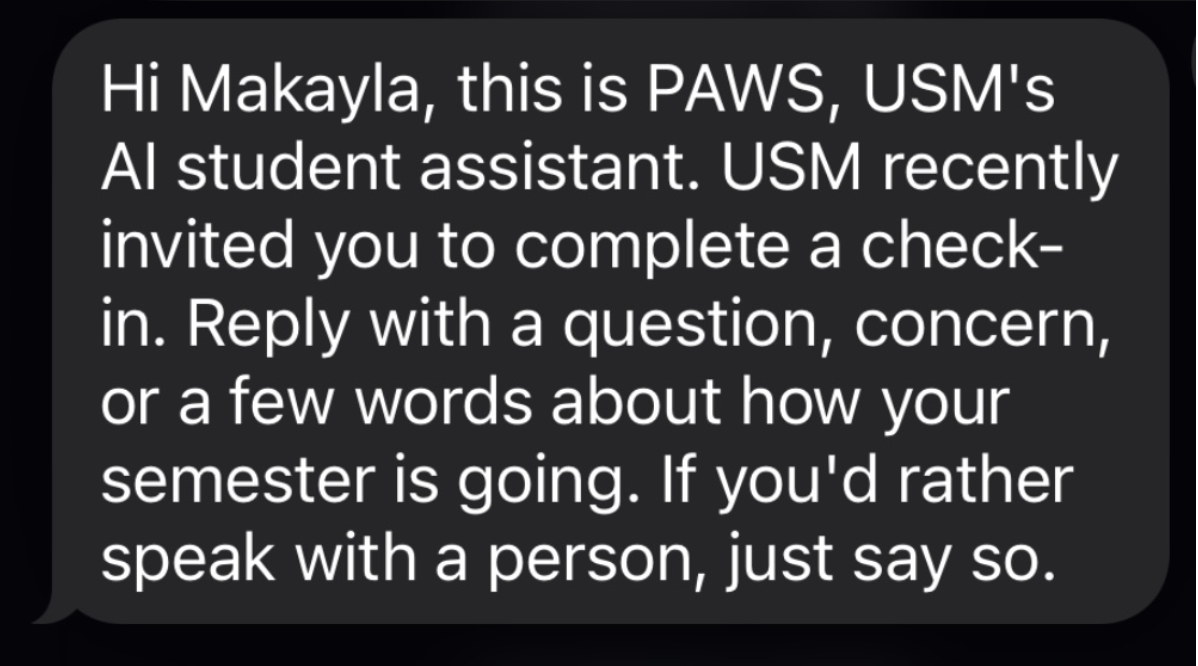
”Students expressed that they were unclear about what this meant, when they consented to this, and broader concerns about how their data was being used and accessed by PAWS.
Not every student at USM received this text message. The students who received this message did not do the three-week check-in that the university sent out.
Staff members of The Free Press sat down with USM’s Dean of Students Rodney Mondor to discuss the new chatbot and its implications for students.
When asked about the chatbot, Mondor said, “It’s just another tool.” According to a study done by Navigate, which is a student application used by colleges and universities and is responsible for the chatbot, 82% of outreach from students occurs after office hours.
If you respond to PAWS AI’s text and ask to speak with a real person, PAWS responds by giving you the full name and email address of your advisor(s).
Additionally, the chatbot has access to students’ majors, minors, GPAs, and more information.
Mondor said PAWS was released on Aug. 1, after being trained throughout the summer.
PAWS is available via text message and on Navigate.
Mondor, as well as Jack Moore, Navigate Project Specialist at USM, have access to everything that students send to PAWS AI.
Mondor claimed that in order to observe trends and the needs of students, they can see any content that is sent.
However, messages are not shared with others outside of the university, aside from Navigate.
When discussing the access he has to chat history and student replies to PAWS, Mondor stated, “18 students were more curt.”
After seeing these messages, Mondor reached out to those students and let them know he could see their messages with PAWS, and checked in with them.
Some students have voiced concerns over how the student body was supposed to know their messages were being read by a person, when this information was not shared with them.
“There’s always that human part of following up if there’s an issue,” said Mondor.
According to the Navigate handout, the AI chatbot is able to answer questions such as “When can I register?”
However, when put to the test, PAWS simply responds, “I’m not able to provide specific registration dates. I recommend checking your MaineStreet account for your registration window or contacting your advisor… for assistance. Need help with anything else?”
Mondor stated that the main purpose of PAWS was for students to get the information they need directly when a human is not available.
When asked other questions referenced in the handout, such as USM’s add/drop period, PAWS says, “I’m unable to provide specific dates for the add/drop period.”
Mondor says students have their phone number in MaineStreet, which is why they receive these texts. If you reply “stop” to the chatbot, you will continue to receive communication, but in the form of emails.
Students have raised concerns about privacy with the new AI chatbot. Specifically, some students were concerned about potential FERPA violations. If a student leaves their phone unlocked and someone accesses the chatbot, they will then be able to get information about that student, such as their GPA.
Mondor said the same case can be made for a student’s email account.
He said his biggest regret was not making an announcement about the rollout of the chatbot.
“We probably should have paused on PAWS,” Mondor stated, saying that he contemplated making an announcement via Instagram about the bot.
USM currently has a Navigate Advisory Committee, which consists of representatives from key departments such as advising, financial aid, and health services.
When asked if it would be beneficial to have students on the committee, Mondor pointed to students not wanting to sit through “boring” meetings.
“We do pull in students when we test things,” Mondor said, discussing the conversations that he had with Orientation Leaders (OLs) and Resident Assistants (RAs).
A few OLs stated that they were still somewhat unclear on what PAWS was, how it would be used, and if there were expectations for them in regard to the chatbot.
When asked what RAs were told about the chatbot over the summer, one RA said, “PAWS was a new AI bot they were gonna be using. That’s literally all we were told.”
Mondor also said that PAWS will speak in different languages to students. However, when a student tested this by speaking German to the chatbot, it responded solely in English.
When asked the question about why some students get different information than others, such as PAWS not showing all of their advisors, Mondor said he would look into that.
“I can be you on my end and text it,” Mondor said, explaining that he could look at the student view, and text the chatbot, posing as any specific student. “I can impersonate you.”
In reference to student concerns about their information being shared, Mondor stated, “People think Big Brother is watching. I’m Big Brother.”
To ensure successful implementation of the chatbot, he said, “We are trying to be as preventative as we can instead of reactive.”
PAWS is not a replacement, Mondor claimed, but more of an assistant.
Many students, however, remain unclear about the chatbot’s introduction and wary of how they were informed about its use.
As USM continues using PAWS, questions remain about how the university will communicate its purpose, address student concerns, and ensure students understand when they are interacting with an AI tool.