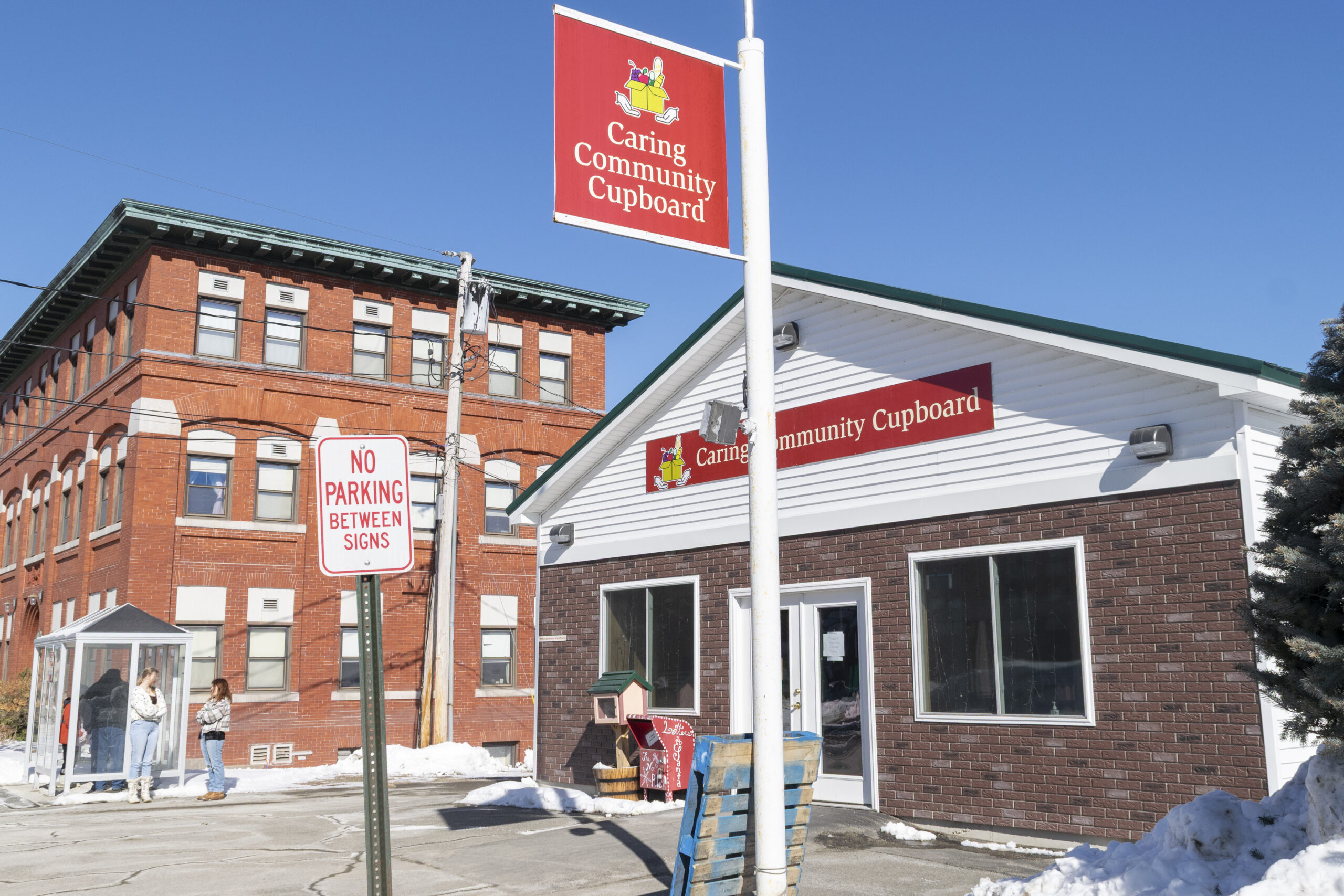
On one chilly Tuesday afternoon, I decided to visit the Old Town Caring Community Cupboard, a food pantry located near campus in Old Town.
As I stepped inside, a wave of warm air and overlapping voices met me at the door. Volunteers moved quickly between shelves, carts rolled across the floor, canned goods clinked as they were stacked and sorted. The space was small but lively. Most of the volunteers were adults — the majority were elderly people and only two were high school students.
“No UMaine students at the moment,” said Tammy Allen, who used to conduct volunteer trainings and has been with Caring Community Cupboard since they opened in Nov. 2021.
At the entrance, Linda Bryant, the Operations Manager at the Cupboard, welcomed me with her husband. They introduced me to Susan Laskey-Curtis, the volunteer coordinator and chair of the board of directors. She began explaining how the pantry functions and the critical role it plays for families in the area.
The Old Town Caring Community Cupboard does not operate like many traditional food pantries. Instead of distributing pre-packed boxes, it allows visitors to choose their own food.
“They come in here and we let them shop basically with a shopping cart,” said Curtis. Each visitor is paired with a volunteer, called “a shopping buddy,” who helps them select items.
Such a system requires a carefully structured schedule. The pantry is open only on Tuesdays. Not by choice, but by limitation.
“The demand is great and our resources could be completely depleted if we were open any more than that,” said Curtis.
She then explained how scheduling works, given the pantry is only open once a week.
“For each shift, so the morning shift from 10 a.m. to 12 p.m., we have between 14 and 17 volunteers,” she said. “And then between 14 and 17 [volunteers] from 4 p.m. to 6 p.m.” Early in the morning, around 8 a.m., four to six volunteers arrive to set up the space.
Beyond what shoppers see on Tuesdays, there is additional work happening throughout the week. Volunteers pick up food from stores, transport ordered items and coordinate donations.
According to Curtis, due to the ongoing extreme cold and snowy winter, demand at the pantry has felt sharper than ever before.
“When it’s been extremely cold, our elderly have not come out,” said Curtis. Many regular shoppers are older, and mobility becomes a barrier in icy conditions. At the same time, cold weather brings others in.”
“Our unhoused shoppers, our neighbors without walls, they come in especially when it’s cold,” said Curtis. At the most recent count, the Cupboard was assisting 17 unhoused individuals.
A green clothespin clipped to a cart signals that the shopper may be living outside or in a car. This means the volunteers cannot give unhoused people foods that might freeze or spoil easily since those customers most likely don’t have a fridge.
“We ask them, what can you store? What storage space do you have?” said Curtis. “In summer, coolers with ice packs are distributed to help keep items cold. In winter, the focus shifts to preventing food from freezing. We have to be very mindful of what we give them.”
Volunteers prepare special bags with crackers, peanut butter and other non-perishables. Many unhoused shoppers have access to hot water through the Old Town Public Library or other public buildings, so the pantry provides soups and macaroni that require only hot water.
This Tuesday morning, 71 families came to shop.
Jimena Estrada Perez, 14, a student at Orono High School, has been volunteering at the Cupboard since July 2024. She makes sure her Tuesdays are always free, as volunteering brings her “peace and happiness.” When she first arrived in the United States, her family shopped at a food pantry in another town.
However she worries many simply are not aware of the opportunities available locally.
“I don’t believe many high schoolers or university students are really aware of this unless they go out and do their own research,” said Perez. If the pantry expanded onto platforms like Instagram or TikTok, she believes it could reach a larger audience.
Curtis also confirmed that social media support is one of the biggest needs.
“There are a lot of ways university students and young people can help us,” said Curtis. “They can help us manage social media. They can help us spread the word. They can do food drives.”
The Cupboard does not have a website. Its Facebook page is the main source of information and outreach. Curtis suggested that if UMaine students are willing to help the Caring Community Cupboard become more active on social media platforms and create content that will more easily reach the public, it would be of great help.