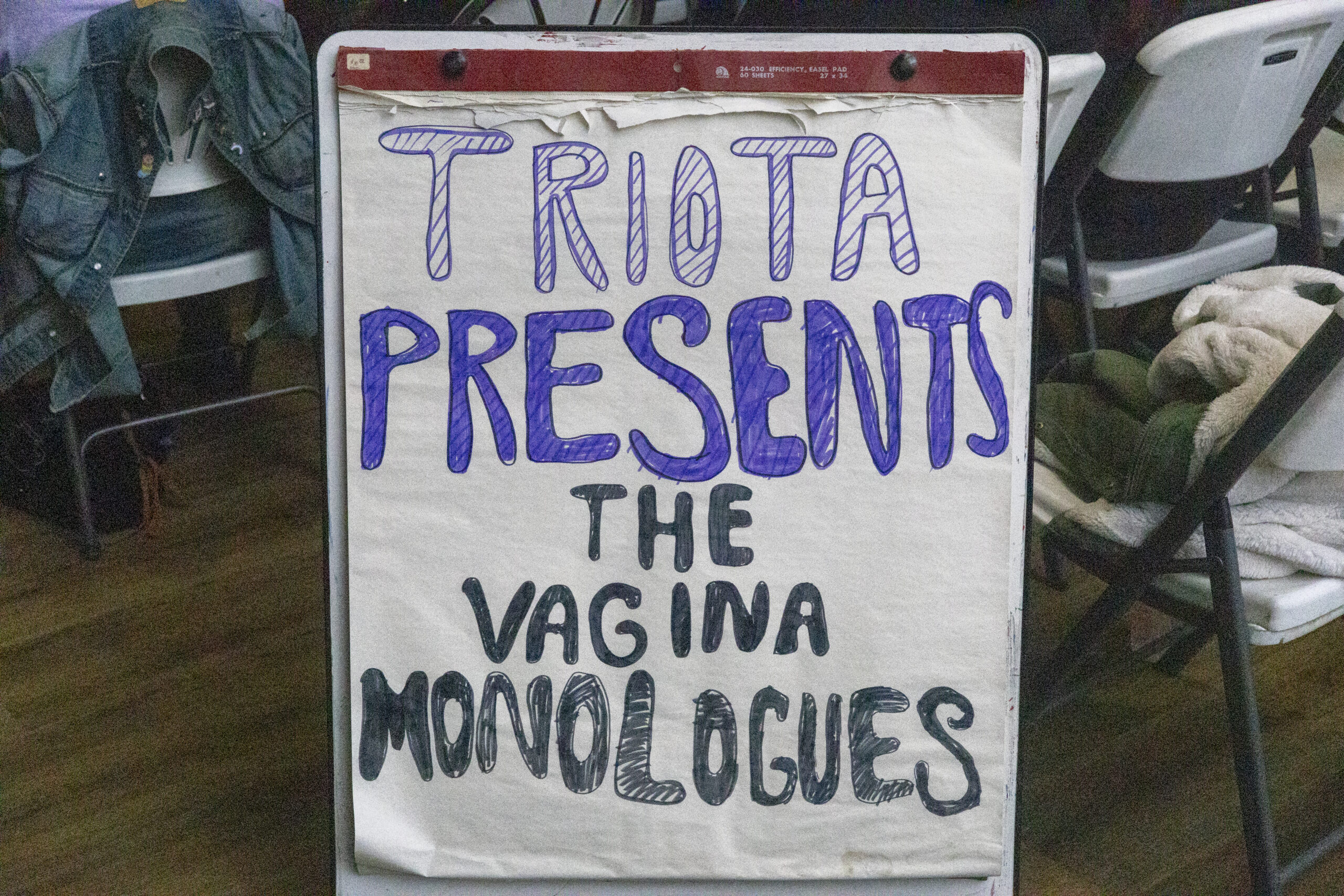
You enter the Wilson Center. Immediately you are prompted to take off your shoes. Not verbally, rather by the pile of shoes that sits in your way. You walk down to the lower level of the room that is full of folding chairs and a table brimming with glow-in-the-dark condoms and sex toys of all natures. Thin veils of woven fabric hang above your head, with soft lights illuminating the coziest room you have seen since the mindfulness retreat you went on years ago with that one ex that nobody speaks of. These are the Vagina Monologues, a long standing tradition full of experiences of those with a vagina.
This year’s Vagina Monologues were hosted by Triota in conjunction with the Mabel Wadsworth Center, a reproductive health center located in Bangor which offers everything from safe abortions to mental health care. They hosted a raffle for the sex toys on the table, donated by Adam and Eve in Bangor, with proceeds going towards the organization. This was introduced by Aspen Ruhlin of Mabel Wadsworth, with a message to take advantage of the services they offer.
What made this event special was the raw and unfiltered nature of the performance. There was no censoring, and there was certainly no shame. The very first monologue jumped into the bushes, literally, as it narrated a woman whose husband would only have sex with her if she shaved. But to her, shaving made her feel bare and childish. It emphasized the pain of razor bumps and the removal of an important barrier between overstimulation and pleasure. “You can not love the vagina unless you also love hair. Many people do not love hair. My first and only husband hated hair. He said it was cluttered and dirty,” read Justice Joy, third-year theatre student at the University of Maine.
In between each monologue was an interlude, with vagina facts courtesy of student Matthew Cummings. It began with “This is a vagina fact: the clitoris is pure in purpose. It is the only organ in the body designed purely for pleasure. The clitoris is simply a bundle of nerves, 8,000 nerve fibers to be precise. That is a higher concentration of nerve fibers than is found anywhere else in the body, including the finger tips, lips and tongue. And it is twice the number in the penis. Who needs a hand gun when you have a semi-automatic?”
This was followed by light laughter, a subtle but effective way of breaking the ice and easing tension among the crowd: the unease due to such a taboo subject. It was not long before everyone was captured by the actors, reeled into a rendition of a raw vagina-owner experience.
Narrated by Danica Soule, fourth-year women and gender studies and child development student at UMaine, she describes a youth full of derogatory terms thrown at her vagina: “Roast beef, my favorite food, being used against me to describe vaginas. My world was spinning. Who on earth would say something like that? The penis is a vile, fleshy worm that I don’t judge. I would never judge a man for what’s natural to him.” Soule gave an invigorating and no-holds-barred monologue, full of crunch and punch that grabbed your attention and threw it around until you felt as angry as she.
Then there was moaning. Every type of moaning, from the “clit” and “vagina” moans to the “mountain top” and “machine gun” moans. These were conducted by Beatrice Klein, a third-year social work and psychology student; a viscerally uncomfortable monologue that felt empowering to make it through. A job well done as far as the audience was concerned.
And before you could even recover: “boy p*ssy.” The audience was whipped around into a heartfelt monologue full of trans representation. This wasn’t just about women, this was about anyone with a vagina, and Charlie Hall was here to tell it how it is. “I love talking about being a dude with a p*ssy. It’s so much fun being able to have multiple orgasms and not needing a break in the middle sex.”
Yet it is not all sunshine and rainbows. For someone who does not fit within the cis-spectrum, it can be difficult to accept who you are when the world pushes against it so persistently. “I did not always like it though. Before taking testosterone, I hated when I bled once a month. I hated that I could get pregnant. I hated that men in my life would negate my emotional experience because I had it. I hated that it existed,” said Hall. This reminded us that it is not the differences that drive us apart, rather the similarities that keep us together. We may not all be men, and we may all not have vaginas, but we sure all have parts of us that take time to accept and love, and it is that very conflict that makes us human.
The monologues were concluded with a final vagina fact, then a thank you to the attendees and a round of applause for the performance. The crowd got up, family and friends congratulated the discussants, and eventually the Wilson Center emptied out as the shoes were reclaimed and the fresh April air welcomed everyone back into the world. It was the same air that was always there, but the crowd left with a new breath. I urge anyone to attend this event next year if at all possible. You may just leave knowing more about yourself and those close to you.