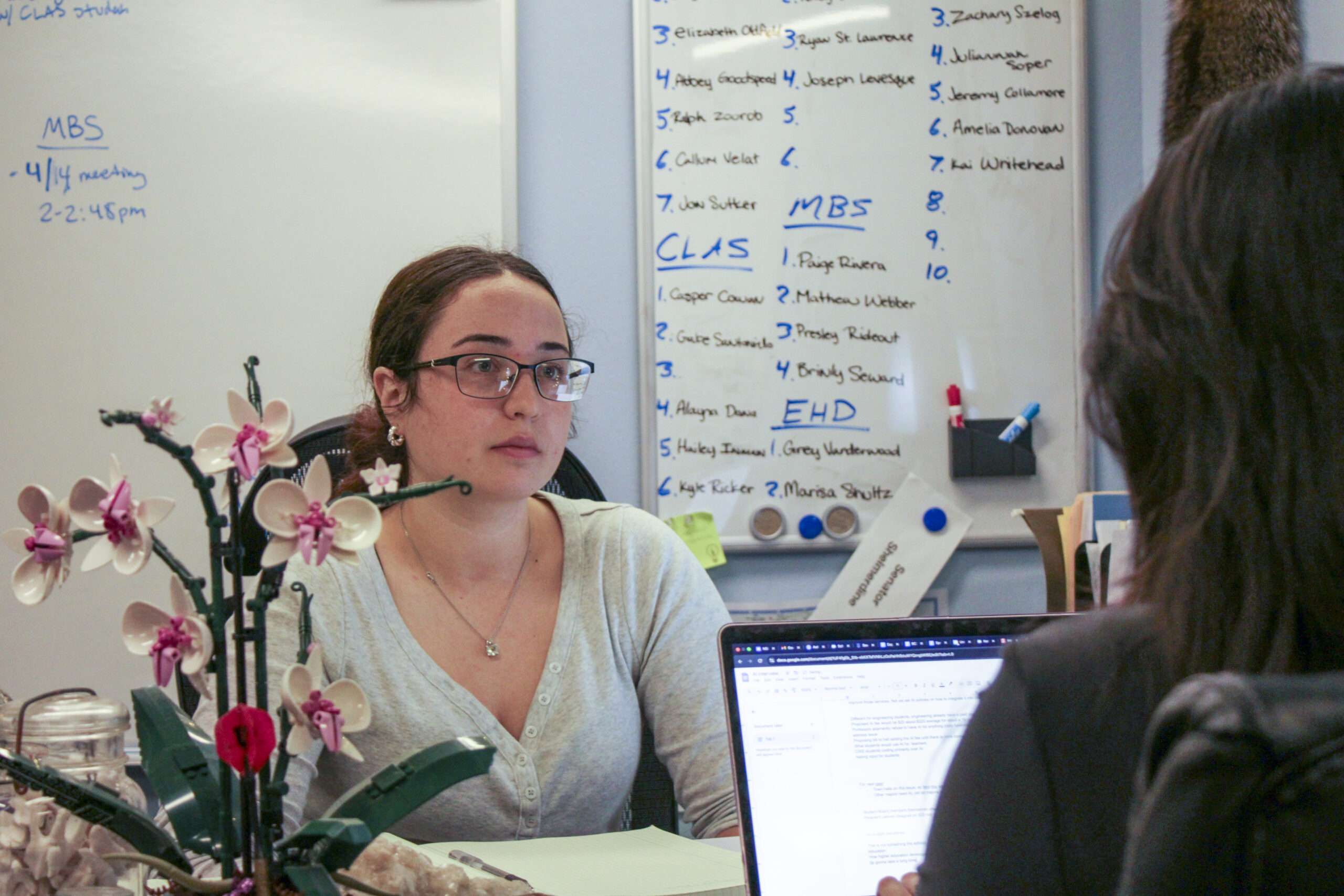
The University of Maine System (UMS) is reviewing proposals that could inform a potential per-credit-hour fee for student access to artificial intelligence (AI) tools, according to a UMS representative, though no formal proposal has been brought before the Board of Trustees. Earlier estimates suggested the cost could reach up to $20 per credit hour, though more recent proposals under review are likely to come in at a lower rate. University of Maine Student Government (UMSG) Vice President and President-Elect Cynthia Shelmerdine said the idea of a new technology adoption and related fee remains under discussion and could take the form of an opt-in service similar to the Academic Materials Program.
Rising concerns with AI have begun to develop across disciplines regarding how its use may be impacting the education system.
On March 11, the UMaine Faculty Senate approved five resolutions from three of its standing committees, with two resolutions focused on the evaluation of AI tools for students: SM2605 and SM 2606, both titled “Resolution Regarding Evaluation of a Per-Credit-Hour Fee Model for Artificial Intelligence Tools.” Each resolution provides recommendations to UMS ahead of a potential per-credit-hour model for AI tools that would be integrated into students’ tuition as an additional fee.
A September 2025 system-wide AI working group issued a public report to the Board of Trustees (BoT), similarly recommending that AI access be funded by a per-credit-hour fee and ensure equitable access to tools and training for the UMaine community.
Samantha Warren, UMS chief governmental and external affairs officer, wrote in an email that “based on the costs of the solutions available at that time (Fall 2025), it was estimated that the per credit hour costs could be as high as $20 and so we did not immediately move forward.”
A system wide fee would be made transparent through a Trustee review process, inclusive to public comment and would require approval by the BoT. Currently there are no proposals before the Board. However, Warren shared that an evolving market prompted university leadership to begin a review process through the Office of Strategic Procurement Request for Proposal (RFP), which stopped accepting submissions on March 27, meaning proposals are currently under review.
Warren wrote that the university expects to implement a solution that costs “far less than was initially estimated in the fall” and they will lean on proposals reviewed by the RFP before UMS proposes a new technology adoption and related fee. She added that this change would mean UMaine joins the “other public institutions across the nation in expanding technology and training access to students.”
This week, Shelmerdine spoke to the Maine Campus to explain the role that UMSG plays in regards to this proposal. She said that the original proposed AI fee includes $20 per credit hour, however, she clarified that “there is currently no set budget for this and it could potentially be an opt in-and-out service, like [the] Academic Materials Program (AMP).”
Shelmerdine believes that a decision about an AI fee “ is not something that the school should take lightly” and that the change “will most likely cause upheaval on how the structure of higher education develops.”
Two UMaine students spoke to the Maine Campus about what the impact of a new fee would look like on the student level. Second-year mechanical engineering student Truston Williams mentioned how valuable access to AI tools can be for engineers, highlighting practical benefits.
“I think that would be really nice actually. I’ve heard some students use it a lot with circuit classes. Personally, I use it a lot in my calculus classes to help me study,” said Williams. “I’ll ask it for practice questions to prepare for an exam and to help me walk me through examples in a specific area.”
Fourth-year student Payton Wingate offered a different perspective on how this issue intersects with her personal and academic life. She voiced doubts about the accuracy of AI-based tools in her field.
“It is pretty common for people to use AI in my field however, the surveying math that civil engineers take has intense trigonometry and in my experience, generative AI cannot do that math correctly,” said Wingate.
Wingate also explained how those in her field must actively balance potential benefits with environmental consequences.
“I have seen AI be praised as a tool, but we also understand the environmental consequences it has. The use of AI continues to deplete water and ruin environments,” said Wingate. “There are also moral qualms related to it, and for that reason, I do not use it all even if professors do recommend it.” She concluded that AI “actively harms it [her field].”
There has been no official announcement on the implementation of an AI-credit fee, but if UMS proposes a new technology adoption and related fee, updates will be provided.