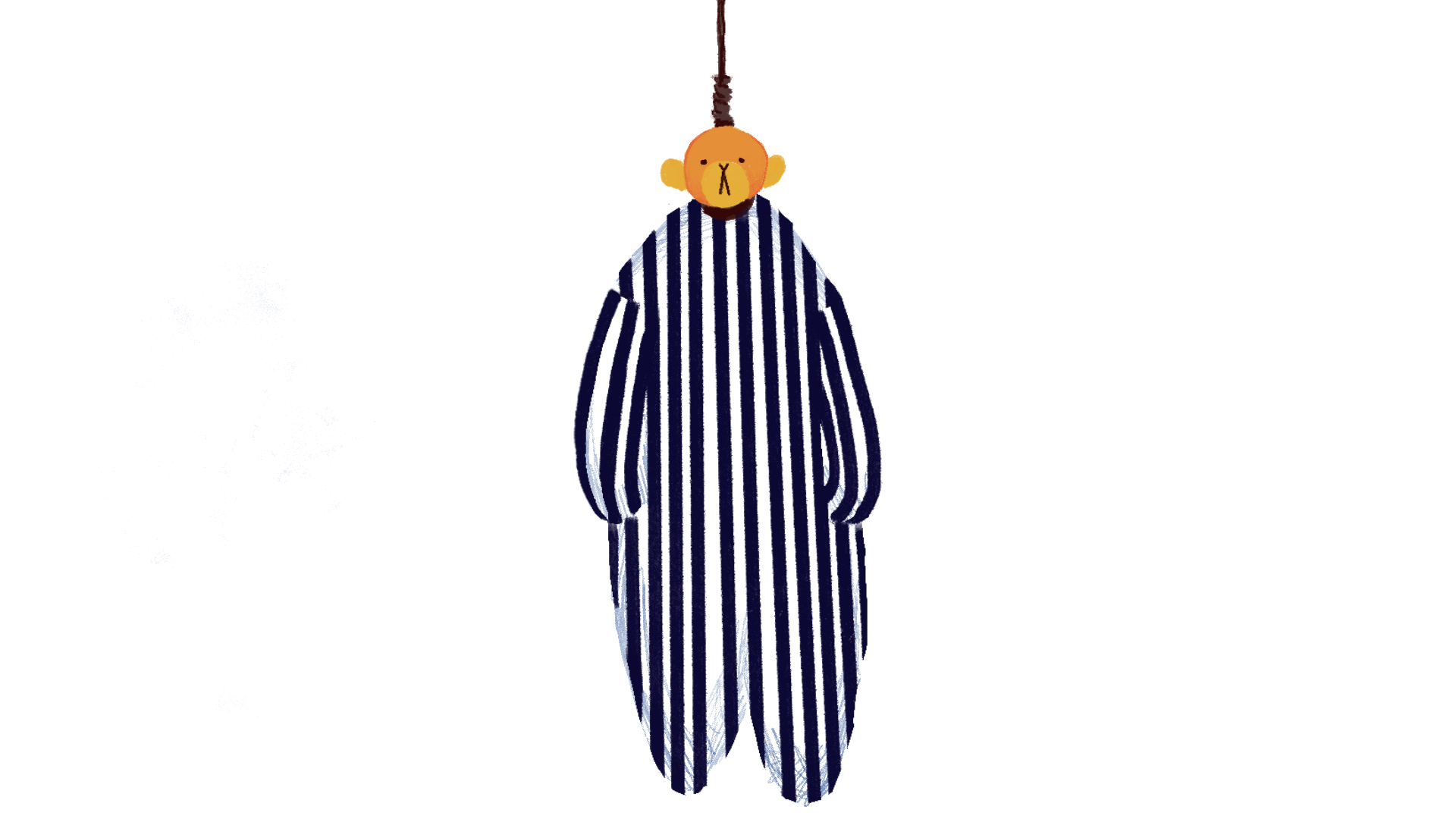
Many people associate the University of Maine with its intense hockey culture. In fact, the head coach of the men’s hockey team, Benjamin Barr is the second-highest-paid regular employee at the university, only out-compensated by the Vice Chancellor of Research. For many years, a major part of our sports culture was the act of ‘hanging the ref,’ a tradition in which students hung a stuffed figure with a monkey head and striped apparel named Bernie in front of the referees as they entered the ice.
That is, until too many people complained and the long-standing tradition was cut. Today, rumors say Bernie lies in an equipment closet somewhere in the Alfond. However, while he may be gone, the memory of Bernie remains very much alive for many students waiting in line for the Friday night game against the University of New Hampshire (UNH).
“I love the ‘hang the ref’ tradition. I remember last year they had that little effigy swinging from the rafters, and that just got me so pumped to watch some friggin’ hockey,” said Zechariah Hoeft, a fourth-year mechanical engineering student at UMaine.
Hoeft was not alone in the sentiment. Cooper Stepankiw, a fourth-year computer science student, said, “I feel like it really just emphasizes UMaine hockey, and I feel like it’s something really important that should be brought back.”
Perhaps the most exciting thing about this endeavor was stumbling upon members of the Maine-iaks. The Maine-iaks are “the official student section of Black Bear Hockey,” according to their Instagram. Three members stood at the very front of the line, making this a great opportunity to ask them their thoughts about the lost tradition of hanging the ref.
“I think we miss it. We reference it every time the refs skate on the ice. You’ll see us swinging our arms. We do understand clearly why we can’t do it anymore, but we do think it’s a fun kind of nod that we do to Bernie,” said Sydney Dayken, biochemistry student and member of the Maine-iaks.
So, did UMaine do the wrong thing by banishing Bernie to the closet? Well, not exactly. What Dayken is referring to is the controversy that surrounded the imagery that the tradition contained. In the context of American history, the hanging of a figure reminds many of a darker side of the culture of the last century. An opinion piece written by Anna Foster for the Maine Campus in 2018 explained it well. “The majority of lynchings in our country were committed during racially charged situations and periods of time where racial tensions, in general, were high. These hangings were used as a way to scare minorities and preserve white supremacy, especially after the end of slavery in the 1860s,” wrote Foster.
Particularly in the current state of American Politics, bringing back such a controversial practice may not bode well for the University. The question is, does school pride trump morality? Currently, that does not seem to be the case. To the Maine-iaks, honoring the memory of Bernie is enough for them. “It’s funny to reference the tradition when people don’t understand it still, and then we get to explain it, and then they get a good giggle out of it. Like the season ticket holders, people who were there when Bernie was created. They get it,” said Molly Graham, finance student and member of the Maine-iaks.
Overall, many students miss Bernie. Yet, even some of those who do miss him recognize the ethical questionability of such a tradition. While the only physical obstacle standing between the return of the stuffed referee and his continued solitude is the closet door, it is unlikely that Bernie will ever see the light of day again, at least not in the context he was stitched for.