OPINION: I had no idea what it would be like to hike on a glacier. As an Ecology & Environmental Sciences student, I think about them a lot, specifically the consequences of their melting. But despite all I’ve learned, it’s been difficult to imagine touching a glacier, much less walking on one for hours. Now, I know. While hiking on the Vatnajökull glacier, I felt like an ant.
That might not sound very profound, but I have truly never felt so small. This wasn’t the only reason for the ant comparison, though. Despite the apparent endless space to spread out, we walked in single file. This was for safety reasons – it was difficult to know what lay under the patches of snow, so the safest place to walk was where someone else had already stepped.
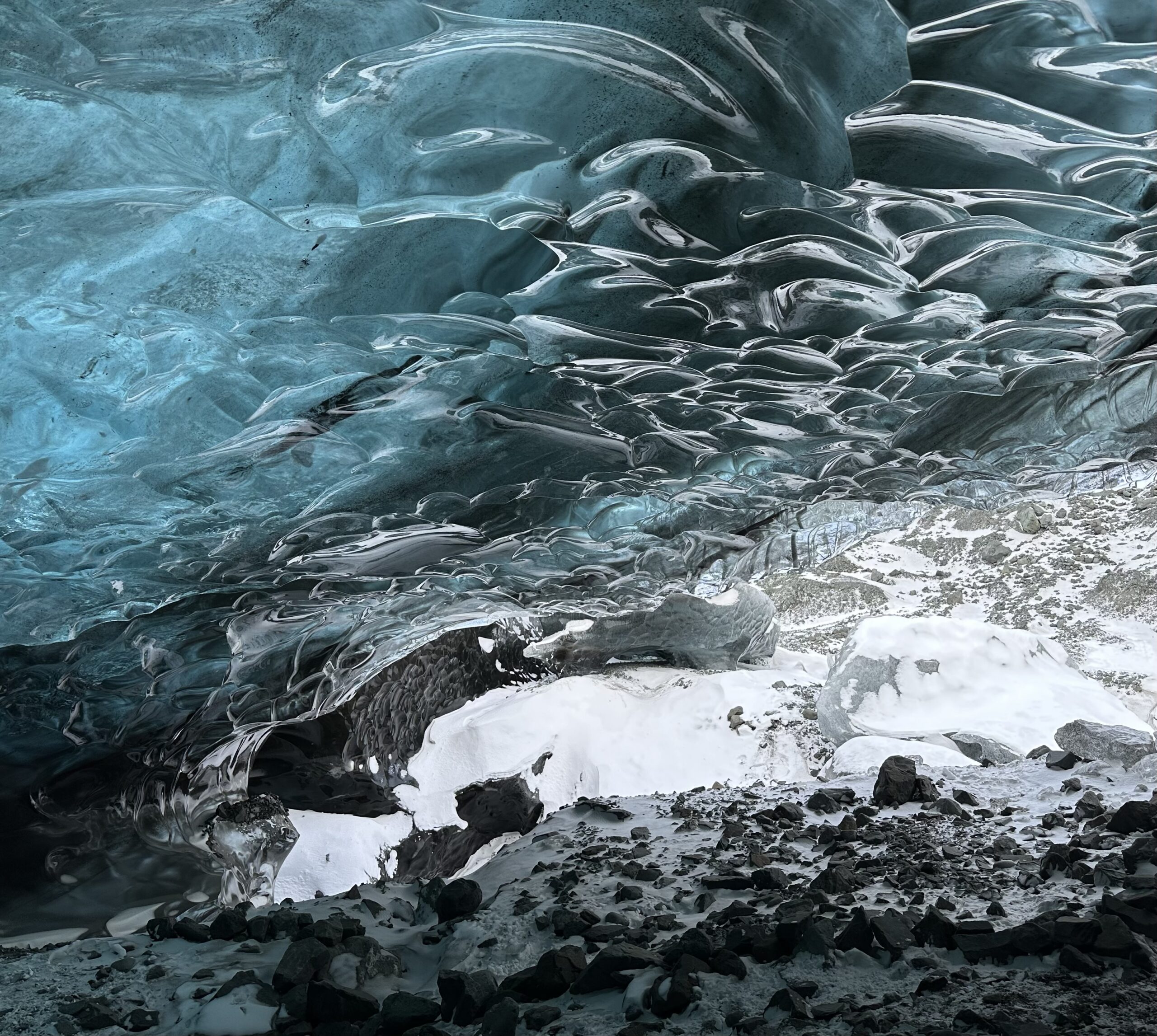
After about an hour of hiking, we reached our goal, an ice cave hidden underneath the glacier. This cave was formed by wind and water, beautiful in a way I had never experienced. But when I first stepped into this otherworldly landscape, I was struck by the idea that I was taking cover from something trying to squish me. My brain was having a hard time making sense of something so incomprehensible.
Before coming to Iceland, I thought of glaciers as the explanation for two things – the boulders in the middle of Maine forests and one of the reasons for the rising sea levels. They had always been a symbol of the distant past, or an ominous future.
While walking on a present-day glacier, I was most concerned with not tripping over my crampons. I spent a lot of time looking at my feet, where the ice was bluer than I’d ever seen. From a distance, glaciers can look like large rivers of snow. Walking on top of them feels more like crossing a frozen lake.
Much like our Maine lakes, glaciers change through the seasons. They form over centuries or millennia, historically growing as the winter accumulation exceeds the summer melt. They move like rivers of ice, inching downhill under their own weight. Trapped within Iceland’s glaciers are air bubbles older than anyone alive today, and layers of ash from volcanic eruptions long ago.
The mixture of the past, present and future in a glacier is difficult to comprehend. For this reason, I had always thought of glaciers as existing on a different time scale, changing too slowly for us to notice in a human lifespan. And yet, the ice cave I visited will likely disappear during the summer.
Despite having studied climate change, I found it difficult to believe that something so vast could be disappearing. How could the glacier be shrinking when it was the ground beneath my feet and only ended with the horizon line? But as we hiked back out, our guide pointed to a rock inscribed with “01 Aug 2022.” This was the edge of the glacier only four years ago. When I stood at that rock and looked at the tiny people standing at the glacier’s edge, my stomach dropped.
Close to us was the Jökulsárlón glacier lagoon. When I visited, I mostly noticed the seals laying in the sun. They looked so satisfied with themselves. The Jökulsárlón glacier lagoon is a popular tourist destination. It’s Iceland’s deepest lake and known for its icebergs, which have broken off from the glacier and are floating out towards the sea. Standing at the lagoon’s edge, it feels like it has been there for ages. And yet, this lagoon is less than 100 years old, formed by the melting of the Breiðamerkurjökull outlet glacier.
The scale of the consequences of climate change are difficult to comprehend. But the changes in Iceland’s breathtaking landscapes provide a clarifying visual.