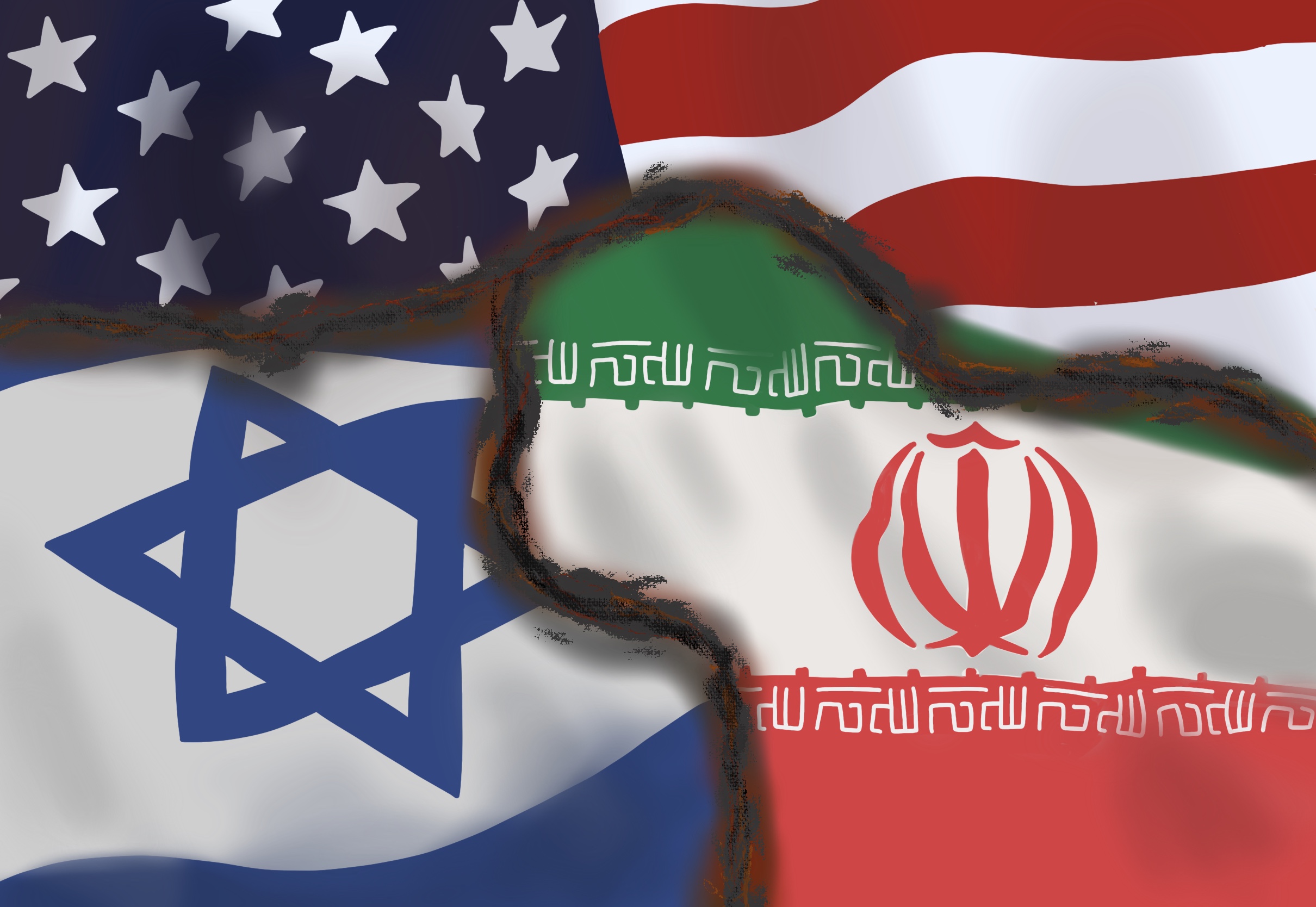
There is, unequivocally, a war going on between the United States and Iran right now. President Donald Trump, elected in large part upon his plank of peace and negotiation prowess, has led 13 American soldiers to their death, along with thousands of Iranian military leaders, soldiers and civilians. Not nearly as life-threatening or historically relevant, yet infinitely more controllable, is the upcoming arrival of finals.
Before jumping into the potentially contentious thesis of this article, I’ll begin with the following statements. I am and always have been a staunch pacifist. War, in any capacity that is not strictly defense of the country, is intolerable to me. The current conflict reveals itself to be not only a backstabbing by a president who promised peace and to ignore the Middle East, but also a great creator of human suffering both within the sphere of violence and with regards to the economic fallout seen around the world. I would seek an end to this conflict now. That is what I believe. Noting that I hold all the above to be true, I also hold this to be true: there is almost nothing any given person at this university can do about it. That is not to say to not care, or not express your opinions as you see fit, but it is to make certain the fact of our impotence.
What is also a fact is that finals are around the corner. It may seem ridiculous to worry more about them than the active war, but that is what is necessary because that is a result that you can control. The world, this country and most importantly you, are doing a disservice by devoting all of your time to protesting or engaging with pro-war ragebaiters. What benefit do you pose to the world by throwing yourself at the wall rather than building up the skills to tear it down? Outrage, justifiable or not, changes and aids nothing. More distressingly, it often becomes a manifestation for avoidance. You can convince yourself that things are bigger than finals, but really you just wanted an excuse to not do them.
There will be those who read this and object immediately. How, they will ask, can one justify turning their attention to exams and essays while people are dying abroad? Is there not something deeply immoral in choosing academic success over moral outrage? These are not unserious questions nor are they asked in bad faith. To care about suffering, even distant suffering, is a mark of basic humanity. But care alone is not action and outrage alone is not influence. The mere act of feeling strongly about an issue does not, in itself, alter its course. One must ask not only whether something is wrong but whether their response meaningfully addresses it.
What constitutes meaningful action? For most students at this university, the answer is uncomfortable; very little of what feels like action actually is. Arguing with strangers online, consuming an endless stream of inflammatory content, or sometimes even participating in protests far removed from the centers of decision-making (though a well planned protest may be the acceptable use of one’s time so long as it’s not the only use of one’s time) may provide a sense of engagement, but they rarely translate into tangible change. These acts are not inherently worthless but they are often mistaken for leverage. They are expressions of frustration, not instruments of power. In confusing the two, one risks substituting the appearance of resistance for resistance itself.
This is where the role of education must be reconsidered. To study, to prepare, to succeed academically is not a trivial chore but an important, self-controlled step toward becoming someone capable of change. The systems that produce war, shape policy and dictate economic outcomes are not dismantled by those who neglect their own development but by those who understand them well enough to challenge them effectively. The student who masters their discipline today is far more likely to influence the world tomorrow than the one who exhausts themselves in unfocused opposition.
None of this is to suggest indifference. The suffering caused by war is real, immediate and deserving of attention, but attention must be paired with strategy. To abandon what is within your control in favor of what is not is not a moral act, it is an impractical one. If the goal is to reduce suffering, to challenge unjust systems or to prevent future conflicts, then one must first ensure that they are capable of doing so.