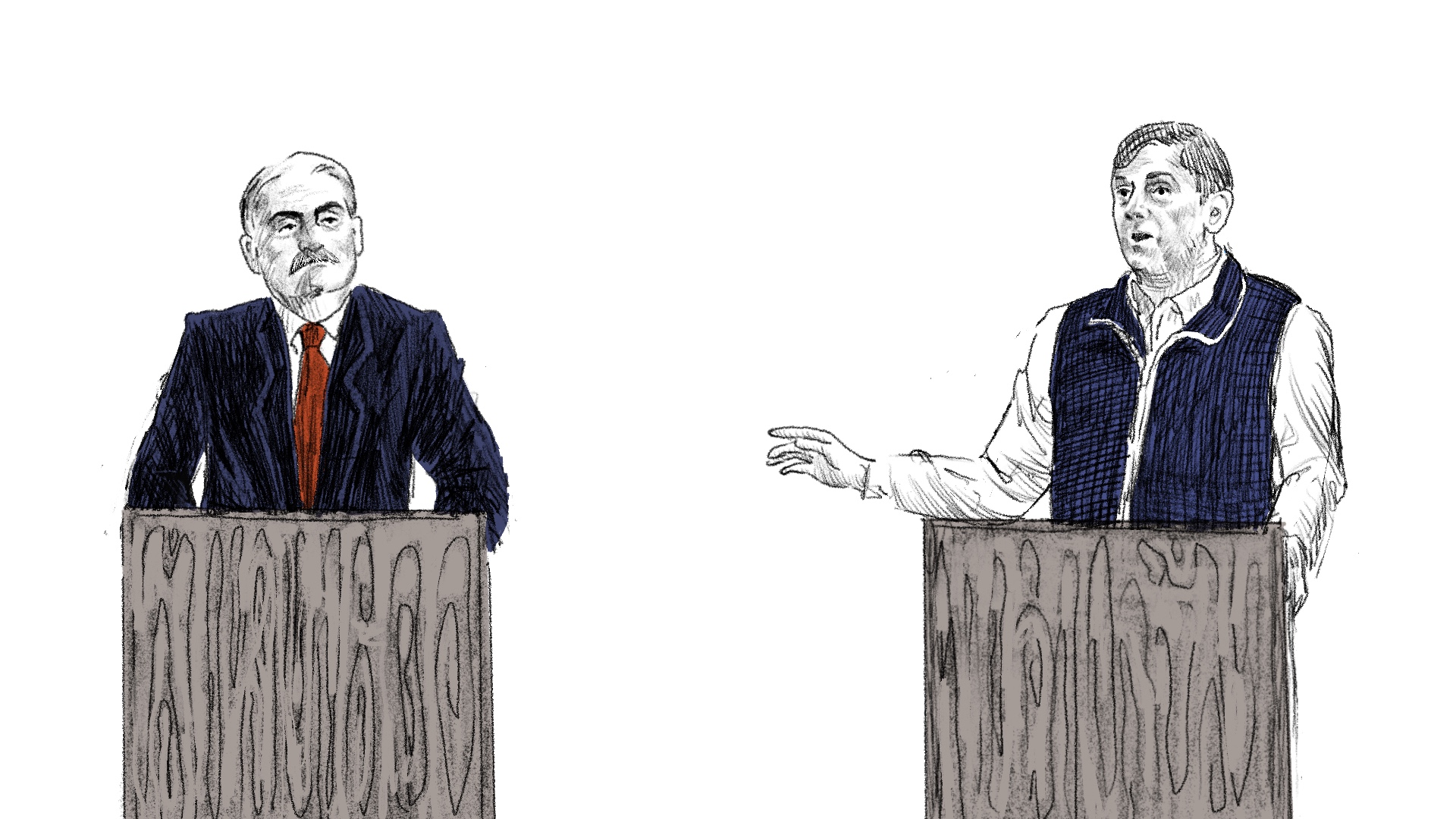
On Feb. 25, Maine gubernatorial candidates Troy Jackson and Bobby Charles met at the Hilton Garden Inn Riverwatch hotel in Auburn, Maine, for a debate. The circumstances of the debate were considered unusual: neither Jackson (a Democrat) nor Charles (a Republican) had secured their party’s nomination.
The Charles campaign has attracted attention in the crowded Republican primary through a robust social media presence, with posts typically drawing on divisive cultural topics and critiques of Maine’s current Gov. Janet Mills. He is closely aligned with the Make America Great Again (MAGA) wing of the party led by President Trump, often commenting on the state’s Somali community and questioning their dedication to American values.
Jackson’s campaign often promotes his close ties with organized labor. The Allagash lumberman, who retained his union membership even during his stint as state senate president, routinely clashed with Gov. Mills over the course of her tenure from issues ranging to her veto of an expanded farmworkers’ minimum wage to her vetoes of several bills recognizing the sovereign status of the Wabanaki nations who inhabited Maine prior to European colonization.
Both candidates have interacted with the Orono community during their campaigns. In mid-February, Jackson appeared at a town hall hosted by the UMaine Graduate Workers Union, an organization he supported the recognition of during their two-year contract negotiation. Charles visited UMaine in August, appearing in a social media video critiquing leftist ideals outside the Orono Public Library.
Charles said he is promoting a “back to basics” platform, promising “lower taxes, lower crime and no more of this woke nonsense in our schools.” In his rebuttal, Jackson described Charles as an inflammatory candidate targeting the Maine immigrant community in his campaign. Jackson also doubted Charles’ credentials as a Mainer, noting that he had spent much of his career as a bureaucrat and lobbyist in Washington, D.C.
Immigration and issues surrounding it were by far the most well-tread topic of discourse between the two gubernatorial candidates. Charles, when asked whether immigrants were a net positive or negative for the state of Maine, asserted that his “quarrel is never with those who come here legally” but instead those who circumvent the law by arriving illegally.
Charles said that Lewiston was now riddled with “bullet holes all over everything” and that there were “illegal aliens” overrunning state infrastructure and introducing drug trafficking. He also often invoked the ideal of the American Dream, and clarified that he believes “everyone” should have the access to the opportunity this ideal promises. Jackson responded by saying Charles “wants everyone except immigrants to have the American Dream.”
Charles said ICE’s actions are “completely constitutional,” although noted that if he were in President Trump’s position, he would not have allowed ICE agents to wear facial coverings that obscure their identity. Charles said that Maine Democrats had “ruined the relationship between Maine and the federal government.”
Jackson said that ICE had broken the law in Maine, claiming they had falsified records and violated the constitution. He asserted that he would arrest any ICE agents operating in Maine if they were found to have committed crimes.
Education and childcare was another topic where the two diverged: Charles critiqued public education in Maine, saying that the state had “pushed indoctrination” and not outcomes; and that “getting woke out of the schools” would be a priority of his, as would reforming the Department of Health and Human Services in order to minimize child abuse. Jackson argued that Republicans had little authority on child abuse, citing President Trump’s widely publicized and years long connections with convicted child sex offender Jeffrey Epstein. He said that he would more forcefully prosecute child abuse cases as governor.
Charles also called for eliminating the state income tax. Jackson implied that his administration would sue Big Pharma and “make them pay” for promoting opioids for pain relief despite “knowing how addictive” they were.” He decried the lack of attention being paid towards struggling elderly care infrastructure in the state and promised to commit to rebuilding the state’s nursing homes.
Jackson was given the first opportunity to deliver a closing statement. He repeated his belief that Charles was hurting Maine and said that, while Maine had its share of issues, it would not be possible to solve them as long as politicians such as Charles sought to sow division. Jackson again emphasized his working-class connection, saying that “I know who I am, I know who I’m fighting for.”
Charles stuck closely to the anchoring tenets of his candidacy, replacing a traditional closing statement with an anecdote pulled over while driving and spoke to several “put together” Somali teenagers on a street corner in Lewiston. He said that while these teens were all ambitious and self-starting, they told him that most of their peers lacked similar drives. When Charles asked why they do not share their friends’ mindset, the teens attributed their mentalities to the positive influence of their parents and their faith in the American Dream.