For many new college students, Core Curriculum courses (formerly known as general education courses) can be challenging. Science and math based Core Curriculum courses are often difficult for students who are transitioning from high school life, according to a representative from the University of Maine’s Office of Institutional Research and Assessment (OIRA). Along with the OIRA, a professor, tutors and several students were interviewed to identify community consensus on the structure and quality of Core Curriculum courses at UMaine.
Debra Allen, who works as the Assistant Provost at the OIRA, and Senior Associate Provost Scott Marzilli responded to outreach for statistical data backing average failure rates across core classes at UMaine. In a joint statement, they shared that only 14% of students earned an F-grade in a core class from fall 2024 to spring 2025.
“The vast majority [of undergraduate students], 86%, did not earn an F,” they wrote. “Because these high-enrollment gateway courses are foundational to degree progress, we intentionally monitor outcomes and invest in coordinated, evidence-based supports where they can have the greatest impact.”
Allen and Marzilli explained ways OIRA and the university as a whole have worked to provide resources to students who are failing courses, in the form of tutoring and other support systems.
“The University has expanded student-facing infrastructure such as Knack peer tutoring that provide additional wraparound services to support students academically and holistically while taking these courses,” they wrote.
Allen and Marzilli shared that CHY 121 (General Chemistry 1), MAT 126 (Calculus I) and BIO 100 (Basic Biology) are typically the core classes students struggle most with, so the office is “providing the greatest amount of support” for those courses.
The Maine Campus interviewed two Knack tutors: Aylin Noble-Ramirez, a third-year psychology student, and Thomas Beyer, a first-year microbiology student. Noble-Ramirez noted CHY 121 has a large amount of students coming from a singular professor’s class, estimating about 80%.
Knack tutor Thomas Beyer also said that most of his students tend to come from the same professor’s class. Both Noble-Ramirez and Beyer said that there are resources available for Chatenever’s CHY 121 course, such as review materials and end-of-class reflection forms. Neither commented on the resources offered by the professor, nor did they respond for a request for comment.
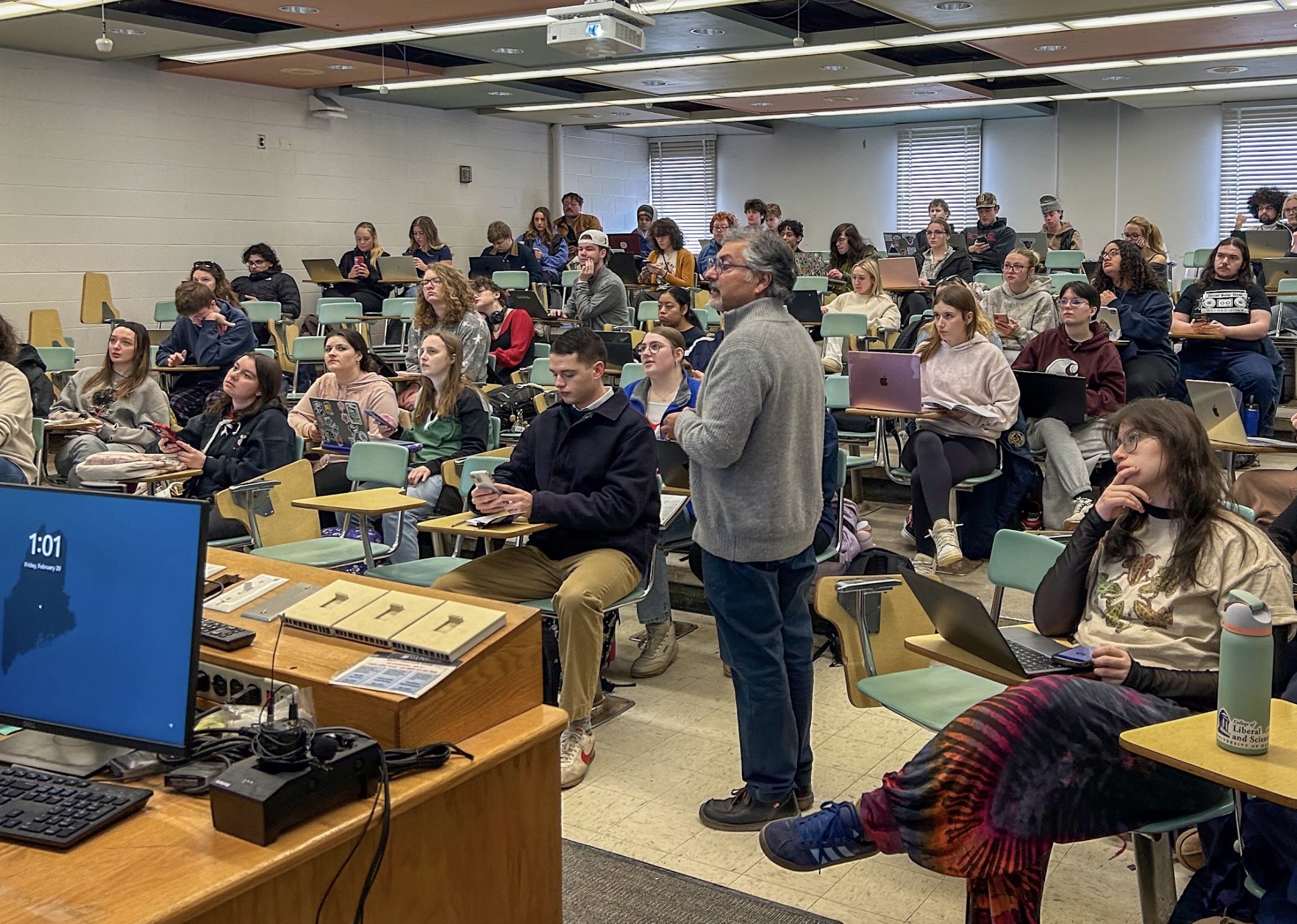
The Maine Campus spoke with Farahad Dastoor, who teaches general education class BIO 100 within the School of Biology and Ecology. The course is offered each fall and is taught to mostly first-year students. According to Dastoor, BIO 100 has a failure rate of less than 20% and students are increasingly given varied ways to demonstrate proficiency without purely relying on exams.
“Grades are a complicated issue, and exams are high stress points. For many years now, we have reduced the weight of exams on final grades while increasing the weight of lab points and lecture-activity points,” said Dastoor. “Students are given multiple opportunities to demonstrate mastery of content.”
Dastoor highlighted that the large enrollment rate must be considered when examining average class failure rates, given that BIO 100 presents a new way of learning for many new students. He also commented on the ways class failures impact both professors and students.
“I acknowledge that anyone failing a class is bad for the student and the instructor and we have tried over the past 20 years to make changes to reduce our failure rate. I never want to see students fail,” said Dastoor.
One form of support available to students is the university’s Maine Learning Assistant (MLA) program. MLAs are students who are paid by the university to attend lectures, answer questions and host information sessions.
Elaborating on the role of MLAs, Dastoor said their presence has been helpful in assisting students who are struggling. The MLAs that attend his BIO 100 course host office hours twice a week. He added that he is frequently in his office as well and students are welcome to come to him during his office hours if they need assistance.
Jace Ankney, a second-year zoology student, took Dastoor’s BIO 100 course in the first semester of her freshman year. She reported that though she had done well, she did have some difficulty with certain aspects of Dastoor’s teaching style.
“I thought that Farahad was a pretty decent professor; he would often listen to students’ feedback and would help them unbiasedly,” said Ankney. “He wasn’t the type of instructor who would give you the answer without making you work for it, which I really appreciated.”
Ankney said one of the more challenging aspects of the course was the heavy emphasis on peer-oriented questions, or questions that foster interaction between classmates instead of with the instructor.
“Although there were things I didn’t like, like how most of the questions were peer-oriented, I can understand how that can help other students. There were also times when class wasn’t very interactive,” said Ankney.
Ankney highlighted the importance of the MLAs, who “walked around, asked questions, [and] were super helpful.”
Dastoor emphasized that he and other Core Curriculum professors are interested in student success, and is happy to help anyone struggling with course material.
“Education is a two-way street; I and the student are working together towards a common goal,” said Dastoor. “New students are not used to being part of the process because high schools do not prepare students for it.”