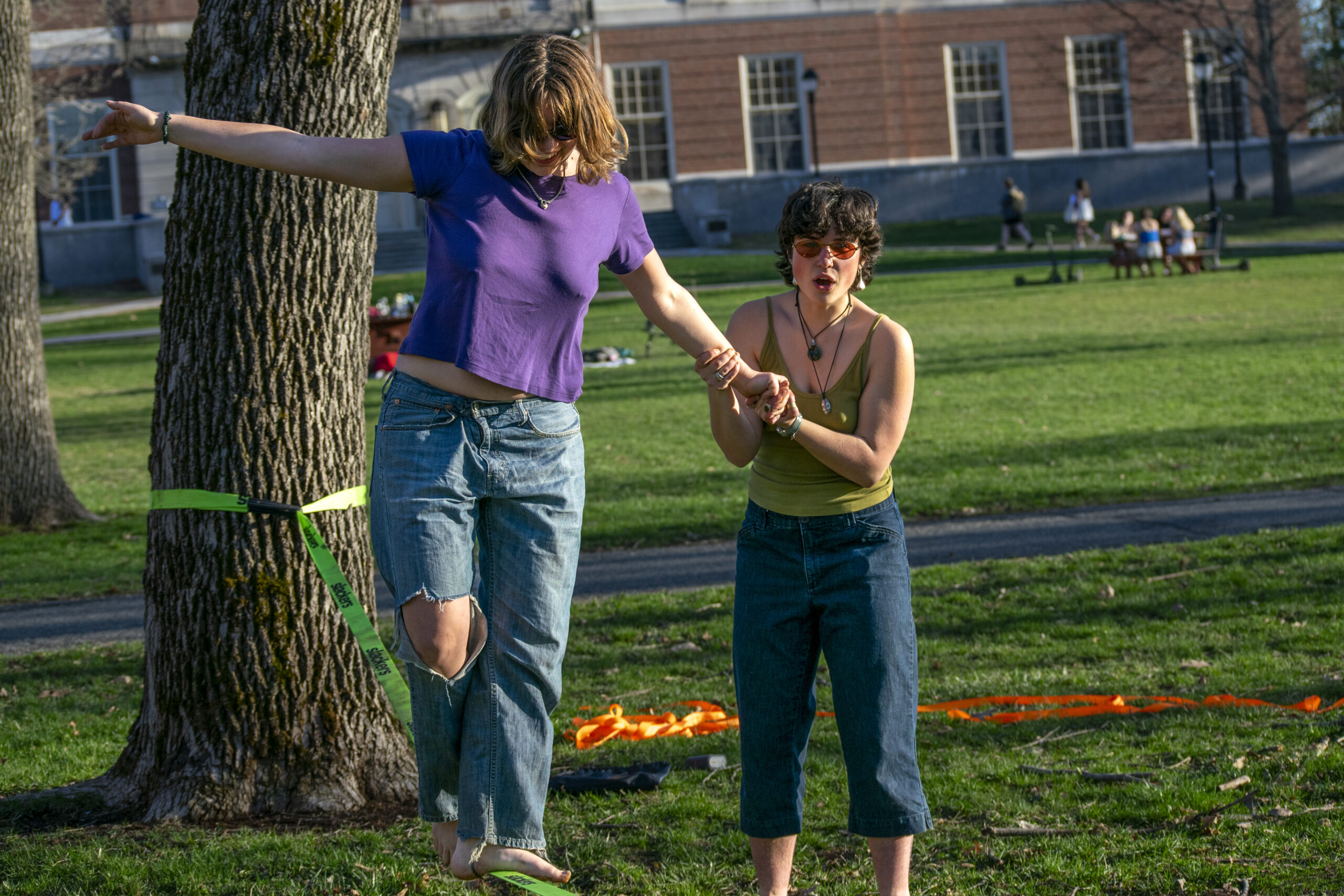
Walking outside you’re met with hordes of people laying on blankets that speckle the quads, a frisbee flies over the muddy mess between the sections of pavement to be caught by someone in shorts and sunglasses — it’s spring once again.
A long, bitter winter went kicking and screaming but it has finally abated halfway through April. As life returns to the leaves and flowers, so too do students return to the outdoor sections of campus.
“There’s a lot more sunlight, the weather’s warmer and that energizes people,” said Angelica Fileccia, the director of the counseling center. “Our brains are conditioned to want to sleep in the dark, so the longer it’s lighter, the more we want to be awake.”
Fileccia talked about how our behavior changes mostly because of how our sleep alters. Waking up earlier in the day and a less oppressive environment outdoors makes it seem like more is possible during the day. On Friday we saw many of our peers take full advantage: going outside in their summer best to make the freest season come as quick as possible.
“As much as possible, try to maintain a similar schedule so that you resist the temptation to stay out all night with your friends because — that’s fun.” Fileccia warned about how diving too quickly into drastic habit changes can also have adverse effects. “You run the risk of getting rebound depression and ending the semester feeling like you have not done enough.”
This regret around what one has done in the course of a semester seems to be a theme in the students who visit the counseling center. Filecci had to say, “We tend to see a lot of graduate students and a lot of students in their third and fourth year with a lot of anxiety around the future. Whereas in the fall semester we tend to see a lot of first and second years adjusting to college.”
Times of change bring about reflection as to what you have really accomplished and what you are changing from. Crucial to keep in mind, is that this year has now passed, there is nothing more to do with it. Only to look forward into the future.
“I get a sense that students are excited about what’s next. Whether it’s because of graduation or an internship or just moving up a year and moving towards more specific study, a lot of positive changes in and of itself is exciting; all of that feeds how people feel.” Filecci mentioned how the opposite side of the coin of paralyzation is planning and excitement.
Not only do students return to campus, but they begin attending to their lives again. Separated from the low hum of the long winter months, plugged into the work of classes chosen what seems like long ago, there is new possibility and a reminder that you are deciding to be here.
“Particularly in an academic setting there can be some feelings of loss and sadness — you know it’s exciting to move on but it’s also sad. Because it is really the end of something pretty momentous,” Filecci added how times of intense change also bring forth heavy emotions.
“We at the Counseling Center can’t necessarily help with every issue, but we will certainly get you in contact with the people who can,” Filecci concluded with the mission of the Counseling Center.
Not everyone finds change and responsibility heartening, for some it is terrifying. Know that you are always supported at the University of Maine and that reaching out to anyone is a good idea. The Counseling Center is on the Gannett side of the Cutler Health Center and no matter your issue, the staff have the ability to connect you to whomever may be best suited to help.
The sun is out and it feels inviting to go take a deep breath of the cool spring air, but don’t forget about yourself. Use your environment to your advantage for energy and happiness, and remember that summer is just a few weeks away.