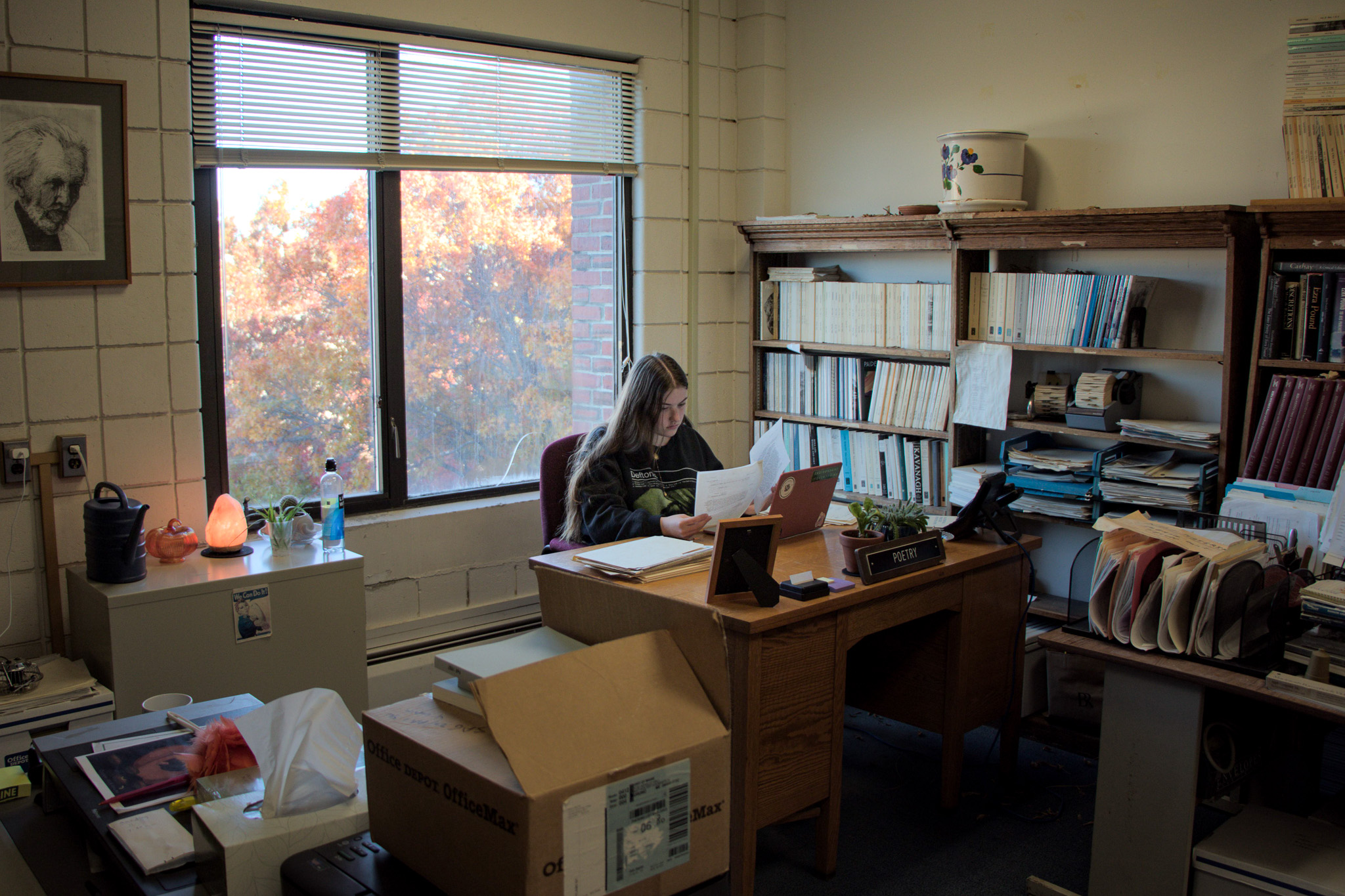
“I’m looking at one now that says, ‘Voices of the Lady: Collected Poems’ and it says Stewart Z. and another name. And when I look through these files, I see the correspondence of these authors,” said Gabbie Needham, a fourth-year secondary education student with an English concentration, who described her job in 400 Neville Hall, also known as the National Poetry Foundation.
Unfortunately, the name is not so indicative of the significance of the foundation, as Jennifer Moxley, an English professor and published poet who joined the university in the year 2000, explained it is more “bravado,” and that “it’s not technically a foundation either.” While there are lost gems of information inside the filing cabinets Needham is exploring, the work is not always so glamorous.
“Some of the stuff that I see is not very interesting,” Needham said. “Maybe it’s a photocopy of the NPF contract or a list of apartments for a visiting author to stay at.” The reason her help is needed is because the task of cataloging is not straightforward. Needham explained how each individual folder is related to one central project, but that inside, the papers are “pretty much just thrown in there,” and that, “the next folder after it might be like five years later.”
“It used to be a working space where books were being made, but the production kind of slowed down to a trickle and now we’re just doing the one magazine and the occasional book,” Moxley recalled. She cited the primary reason for this as a lack of funding. “Those offices had a typesetter and a financial person for years. One retired and then the other is only at a quarter time with the center.” As funds fall, it can be harder to keep people in the room working.
The walls are lined with tens of books written primarily by Carroll F. Terrell (founder of the Terrell House) and Burton Hatlen. Moxley remembered how, “the founders, Terry and Burt, would have a few students involved. Like an intern or an assistant, one or two grad students. But in all the years I’ve been teaching here, I’ll ask my poetry workshops, ‘do you know about this’ and it seems that students never had much interest.” By ‘this’ she does not just mean the happenings in the NPF, but the rich history of poetry and poetics at the University of Maine.
The books are cowritten alongside professors and experts far outside of Maine. The main product to come out of the space was the ‘Man/Woman and Poet’ series. In these books, interviews with renowned writers, transcriptions of lectures and scholarly study tried to characterize and interrogate the style of famous poets.
“I had met Burton at a conference,” Moxley said, “And he had read my work. Part of the reason I wanted to come here as a professor was because of this center and this history of poetics at UMaine.” It seems unfortunate then that a tradition rich enough to draw professors here would be out of mind for the student body.
“The vision of the space now is, how do we make students feel ownership of it and make them aware of the history that they are walking into? Our dream is to clean it all up, you know, fresh and paint, and then on one wall have floor-to-ceiling bookshelves with a big poetry library,” said Moxley.
The goal, as Moxley explained, is to have a space where students will stay and where books can be produced again. As there is nowhere else on campus specifically for poetics, the concentration of books, materials and students is hoped to attract more ideas, energy and excitement.
“Even though my major is so close to English — like it’s ‘Secondary Education, comma, English’ — I felt so removed from English majors. I didn’t feel a sense of community and connection and I guess the hope is that people will,” Needham spoke to her own experience.
Both Moxley and Needham said that they took a chance for this project; Moxley with the offer, and Needham with accepting the internship. Out of this leap of faith, the ball has begun rolling with the potential to bring English majors closer to their history at the University of Maine, and to each other.