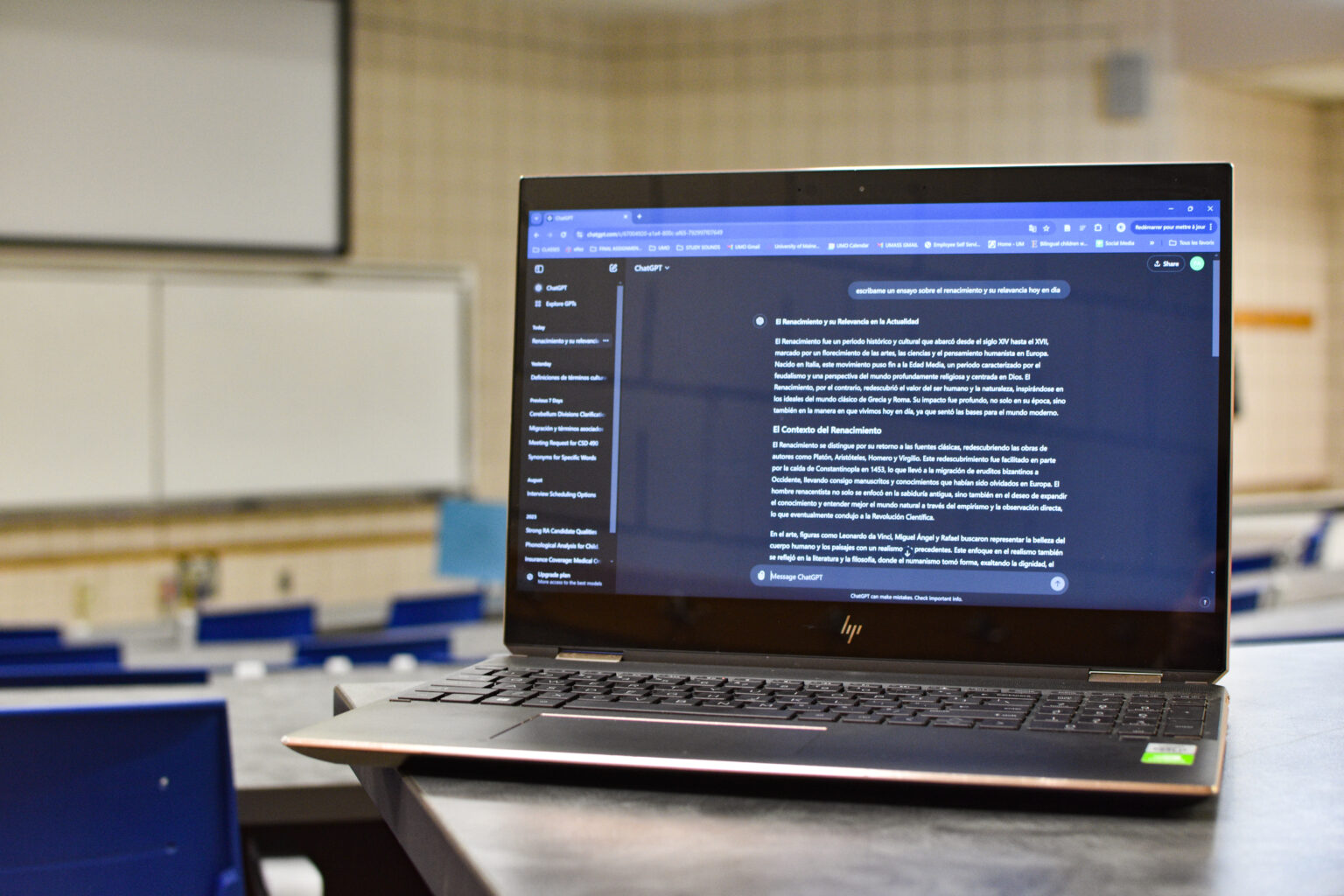
The University of Maine System (UMS) has officially launched system-wide ChatGPT Edu access. All matriculated students, staff and faculty have access to the software through their UMS accounts. The use of the platform is optional and data is not used to train OpenAI’s models. However, UMS has yet to determine how it will fund access to the ChatGPT Edu platform beyond the first year of its two-year contract.
In an Aug. 27 system–wide email, Vice Chancellor for Finance & Strategic AI Integration Ryan Low explained that the implementation of ChatGPT Edu was part of a two-year contract with OpenAI.
“We are providing a platform that is reliable, paid for and integrated with existing UMS credentials and systems,” wrote Low. “Universities have full discretion over where and how it is used and may continue to acquire complementary tools as their academic, research or workflow needs require.”
The email also explained that the model is in full compliance with Family Educational Rights and Privacy Act (FERPA) guidelines, that use is optional and that prompts and files are not used to train OpenAI’s models.
Plans for implementation began as a result of the UMS AI Working Group, formed after a Nov. 4, 2024 Board of Trustees meeting. The group was charged with providing guidance on policy, making a recommendation on AI implementation and promoting use of AI tools that fall within the standards of academic integrity.
It was primarily composed of members of the UMS administration, though one member was a student and another was a faculty member. The group met monthly from October 2024 through August 2025, during which it monitored AI task forces at UMaine campuses, facilitated demonstrations of various AI tools for the working group and conducted surveys on faculty with regards to interest in AI integration.
In September 2025, the working group released its final report. It recommended flexible policy, the development of shared standards for ethical use and the establishment of a new student fee of $18 to 20 per credit hour.
“Implementing this fee in the Spring semester will provide the necessary lead time to establish a comprehensive budget, begin the hiring process for support personnel and finalize software contracts,” the report reads.
The report also references some of the applied uses of AI at UMaine campuses. The working group observed uses across campuses prior to widespread implementation, including using AI to conduct initial screenings of job applicants and grade assignments.
The report says that, “the University of Maine System is piloting AI applications that use large language models to process unstructured transcript data, interpreting and structuring essential academic details such as coursework requirements, grade point averages and credit transfers for admissions review. These transcript processing initiatives remain experimental while FERPA safeguards are finalized.”
In response, on March 11, the UMaine Faculty Senate passed Resolution SM2605 and Resolution SM2606, both titled “Resolution Regarding Evaluation of a Per-Credit-Hour Fee Model for Artificial Intelligence Tools.” SM2605 and SM2606 raised concerns about the utilization of a per-credit-hour fee, arguing that it may disproportionately affect students with financial need and that the educational value of AI varies by discipline.
The resolutions also raised concerns about adopting the fee without “transparent communication and shared governance.” This follows an April 3 letter from the Faculty Senate which raised concerns about the University’s failure to adhere to shared governance in other areas.
The per-credit-hour fee has since been removed from the first year of the contract. The contract is currently funded with revenue generated by the university investment fund. It remains unclear whether a similar fee will be employed in the second year.
“The Board will revisit funding for the second year of the new contract as part of the FY28 budget development process and any student fee or shared services cost would be subject to a transparent, public review process that proactively engages faculty, staff and students,” wrote Low in the system-wide email.
ChatGPT Edu was selected as the result of the UMaine System putting out a competitive request for proposals. The software’s score was based on metrics including cost evaluation, financial risk assessment and compliance with the University of Maine System Master Agreement. ChatGPT Edu scored the highest and the final value of the agreement came out to $1.39 million.
UMaine Chancellor Dannel Malloy spoke on the issue in a May 26 press release.
“While we recognize there are differing perspectives and important questions surrounding the integration of AI, Maine’s public universities have a responsibility to prepare students for a workforce where employers expect them to have the knowledge and skills to use these increasingly common tools.”
ChatGPT Edu was officially made available to UMaine students and faculty on July 1.