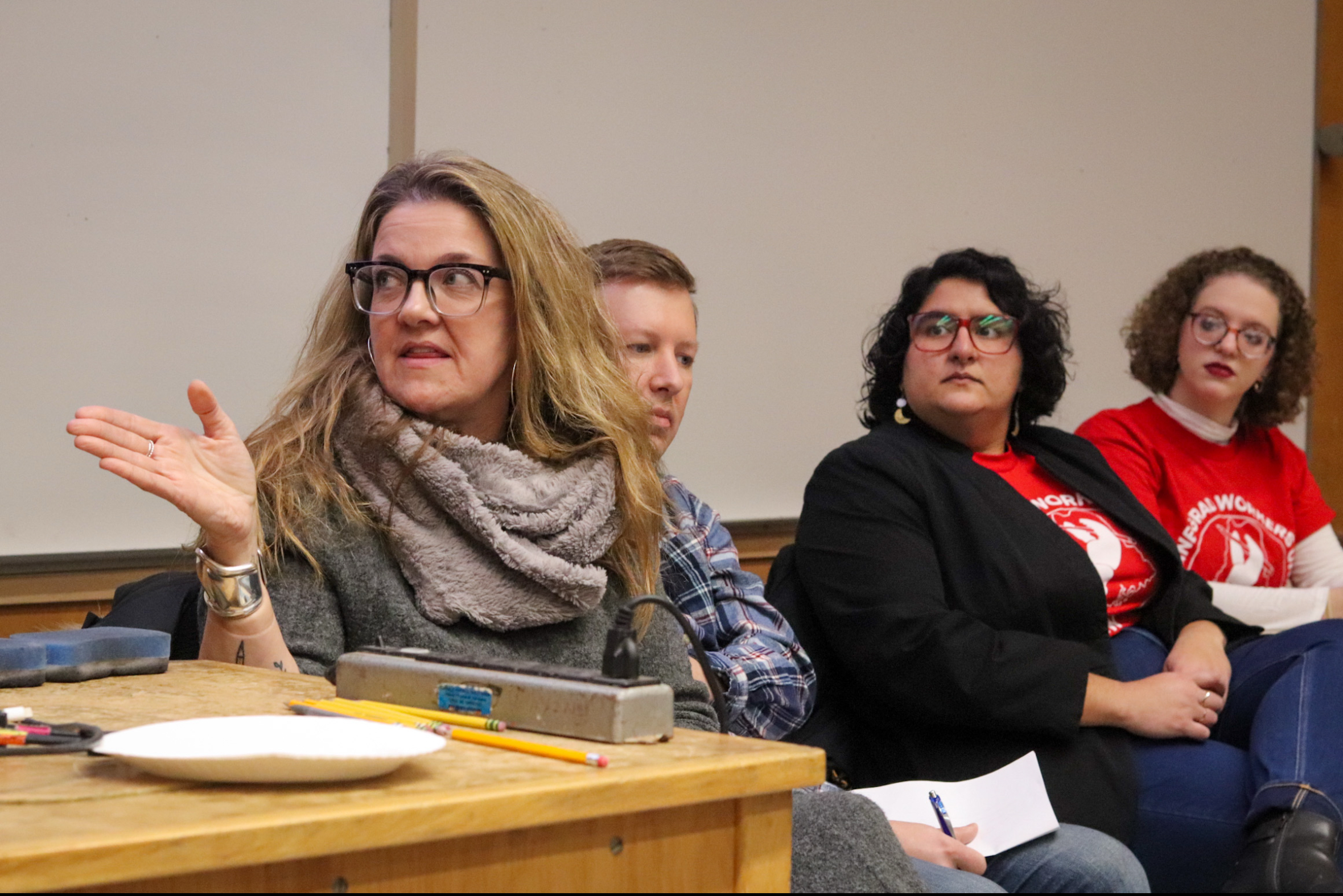
For the past three years, Democrat Amy Roeder has represented Bangor’s 23 District in the Maine House of Representatives. Her term ends this year and she is now a candidate for District 9 in the Maine State Senate, which covers the Bangor and Hermon area. In an interview with the Maine Campus, Roeder discussed her campaign priorities and how her experience as a theatre professor at the University of Maine informs her work as a lawmaker.
Roeder has a BFA in acting from the University of Evansville and an MFA in acting from the University of Georgia. She is also a member of the Actor’s Equity Association and the Screen Actors Guild–American Federation of Television and Radio Artists (SAG-AFTRA).
Roeder is currently an adjunct professor in the Theatre and Performing Arts department at UMaine. She is teaching the online class Intro to Theatre (THE 111), which is being offered next Fall.
As of 2026, she has sponsored and supported numerous Maine laws. Roeder said she is especially proud of the bills she’s helped turn into law and she has a flower tattoo on her arm for each one she has introduced. These include laws that curb no‑knock warrants, extend minimum wage protections to farmworkers, create paid family and medical leave, protect workers’ digital privacy and guarantee emergency prescription refills so people can get essential medication.
Roeder talked about her campaign and how she hopes to balance her work fighting for change in the Senate with her passion for teaching theater. She shared that her efforts are grounded in growing up in a working class family.
“I do not intend to stop fighting for people that look like my parents, that look like my neighbors, that look like my grandparents, and my teachers and just all of the people around me in the same circumstances who are just trying to get ahead,” said Roeder. “[I’m] trying to live a good life where we can provide for our kids, where we can take care of ourselves, and we can retire peacefully and not be wiped out by medical debt, not be wiped out by a predatory mortgage or loans.”
One central pillar of Roeder’s campaign is addressing the housing crisis, especially in Bangor. Roeder notes that there is “a 1% vacancy rate” in the city that makes it “almost impossible to find an apartment” in one’s price range.
Roeder is also focused on the intersection between housing, mental health and substance use disorder, calling Bangor “the epicenter of the opioid crisis in northern Maine.” said there are “a lot of people who are addicted to drugs that we’re not helping.”
When asked what specific challenges facing students she is most focused on, Roeder pointed immediately to housing.
“Speaking of housing, I spoke with a lot of students. I went to a lot of meetings for the graduate workers union, and I heard over and over again how hard it was for them to find housing and how much of their paycheck was going to housing, so they didn’t have money to fix their car,” said Roeder. “They didn’t have money to buy groceries.”
She added that some had to rely on food pantries in order to eat. Students told her that many of the apartments and houses they live in are below code standards, but they were afraid that if they brought it up to their landlord, they would get evicted and have no place to live.
“I think the university has done a pretty good job about keeping tuition low and keeping fees low. But students aren’t going to want to stay here if they don’t see opportunity,” said Roeder.
Roeder has continued teaching throughout her time in office and she intends to keep doing so as long as the department needs her. Roeder noted that she misses the classroom and hopes to return to in‑person teaching if circumstances allow. For her, teaching and legislating are deeply connected.
“Because I know that when I am on the House floor, my mind isn’t just on my constituents. My mind is on my students, too. I’m thinking what kind of world are we building for them? What kind of world are we building for my constituents? What kind of help do these populations need?” said Roeder. “I really feel that being an adjunct here helps me to have a more comprehensive view of who we’re serving.”
When asked whether she would still teach if elected to the Senate, Roeder shared that she would love to keep teaching, but that depends on how much interest her class generates.
“Every department now has these minimums for classes. And every theater department in every university that I’ve ever known is fighting for their existence because people believe that theater isn’t necessary. I beg to differ,” said Roeder. “I think the skills that we teach in theater classes, whether it’s a history class or a performance class or a design class, can be extrapolated outward to any kind of profession you want to be in.”
Roeder also talked about her desire to bridge political divides in order to get things done. She notes that “the only way we ever get anything done is if we listen to each other and we really put in the work.” Roeder also said that she would like to see more young people get involved in the State Committee and encouraged them to become candidates.
“We need a mix of ages, genders and races. We need a legislature that looks like the state of Maine. That includes having young people who are in our amazing universities and colleges,” said Roeder.
See more about Roeder and her legislative items here.