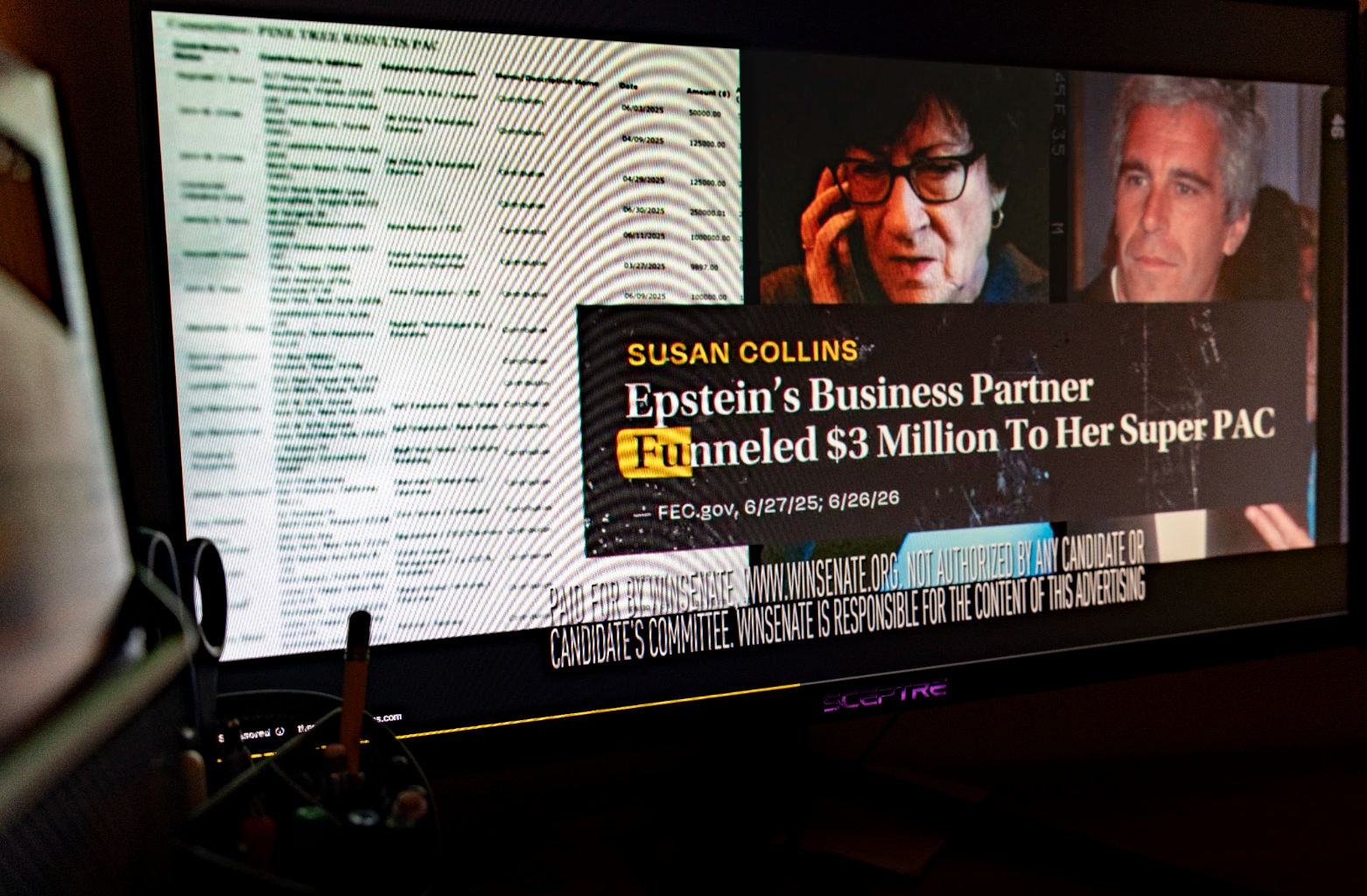
It is no secret that the Senate race in Maine is hotly contested. Republican incumbent Susan Collins and former Maine Senate President Troy Jackson, a Democrat, have been feuding in the media for what feels like forever. For most people of this generation, nasty fights in politics have been the status quo, but this year feels different.
Professor Mark Brewer, chair of the political science department at the University of Maine, told me that “at least for Maine politics,” this malicious fighting “is likely because of how close the race is and how important it is to the national picture.” With the election coming up, I chose to talk to UMaine alumni, current students and Mainers studying out of state to see how things have changed on campus, how students feel about the advertisements and how rhetoric differs at other New England schools.
It seems as though we never stop hearing from political organizations, but has this always been the case? I asked my father, Michael O’Driscoll, a 1990 graduate of UMaine, who said, “there may have been small groups like young Republicans and Democrats, but not really enough to notice” and that “social media wasn’t a thing, so not much outreach.” Although 1990 was only 36 years ago, a world where students were not constantly surrounded by political rhetoric feels completely foreign.
With the advent of social media platforms, outreach has become much easier, but it has also become easier to spread negative messages without directly facing the recipient. A 2024 UMaine graduate, Hannah Batchelder, who now lives in Massachusetts, said that she “[doesn’t] see as many political commercials until it’s much closer to the actual election.”
With the apparent surge of crass advertisements in Maine, how do current students feel? I talked to Emma Smith, a second-year student who serves as the Fair Elections Practices Commission chair for UMaine’s Student Government. She is looking forward to the upcoming election, saying that “any election can bring change which [can be] positive.” As for how she feels about the political rhetoric, she reinforced Brewer’s idea that the aggression has reached a level that is “a little more than necessary.”
Smith and I also talked about how the language used seems to be much stronger, with swear words and offensive nicknames becoming a more common feature of these ads. Smith brought up the point that “most political ads seem to be a similar concept,” where each ad goes back and forth on the same personal matters.
For students here, it may feel that politics in general is heated. To see how Maine’s heated political advertising compares with what students encounter elsewhere, I talked to two native Mainers studying in Massachusetts and Vermont.
Tori Hussey, a first-year political science student at Suffolk University, says that in Maine, “you can’t turn a corner without seeing [political ads],” and “every person seems to have flyers in the yard, or on their window, or even on their vehicle.” I considered that she may just be in a bubble, but when I talked to Chloe Drown, a second-year biology student at Saint Michael’s College, she told me that she “really [doesn’t] see much physical or media advertising.”
This hotly contested race centers in part on how much power Sen. Collins holds in the Senate. As chair of the Appropriations Committee, Collins has significant influence over federal spending, including funding that reaches Maine. That power may be one reason the state’s Senate race has attracted so much attention beyond Maine.