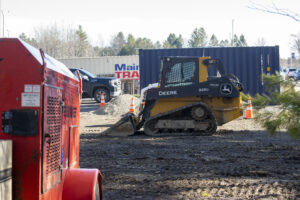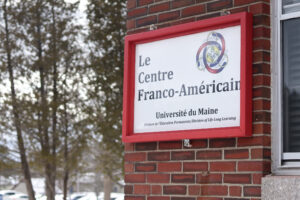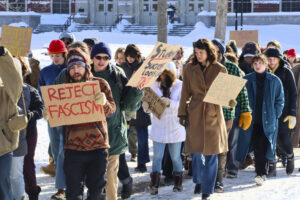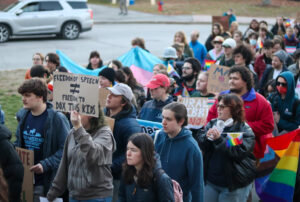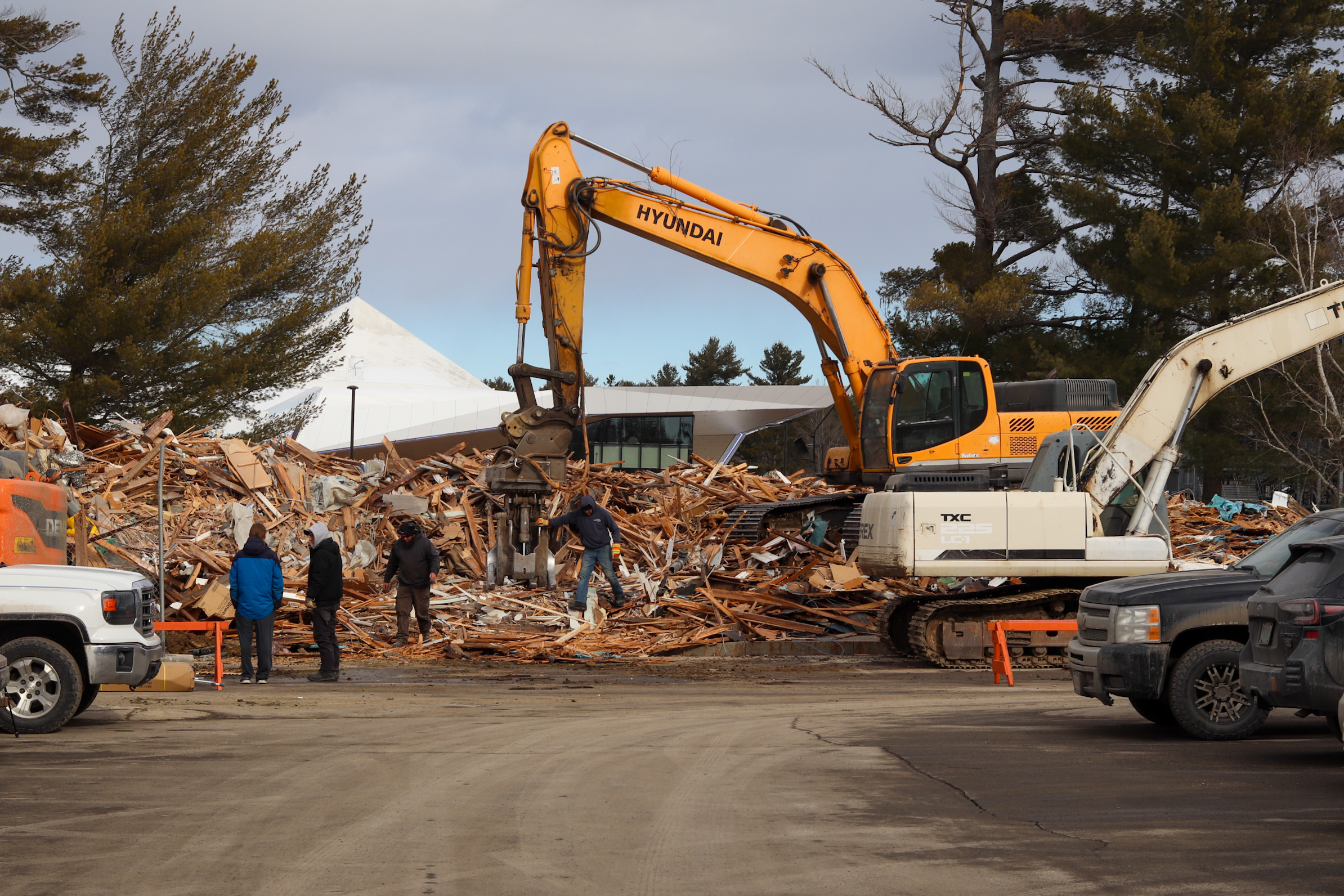
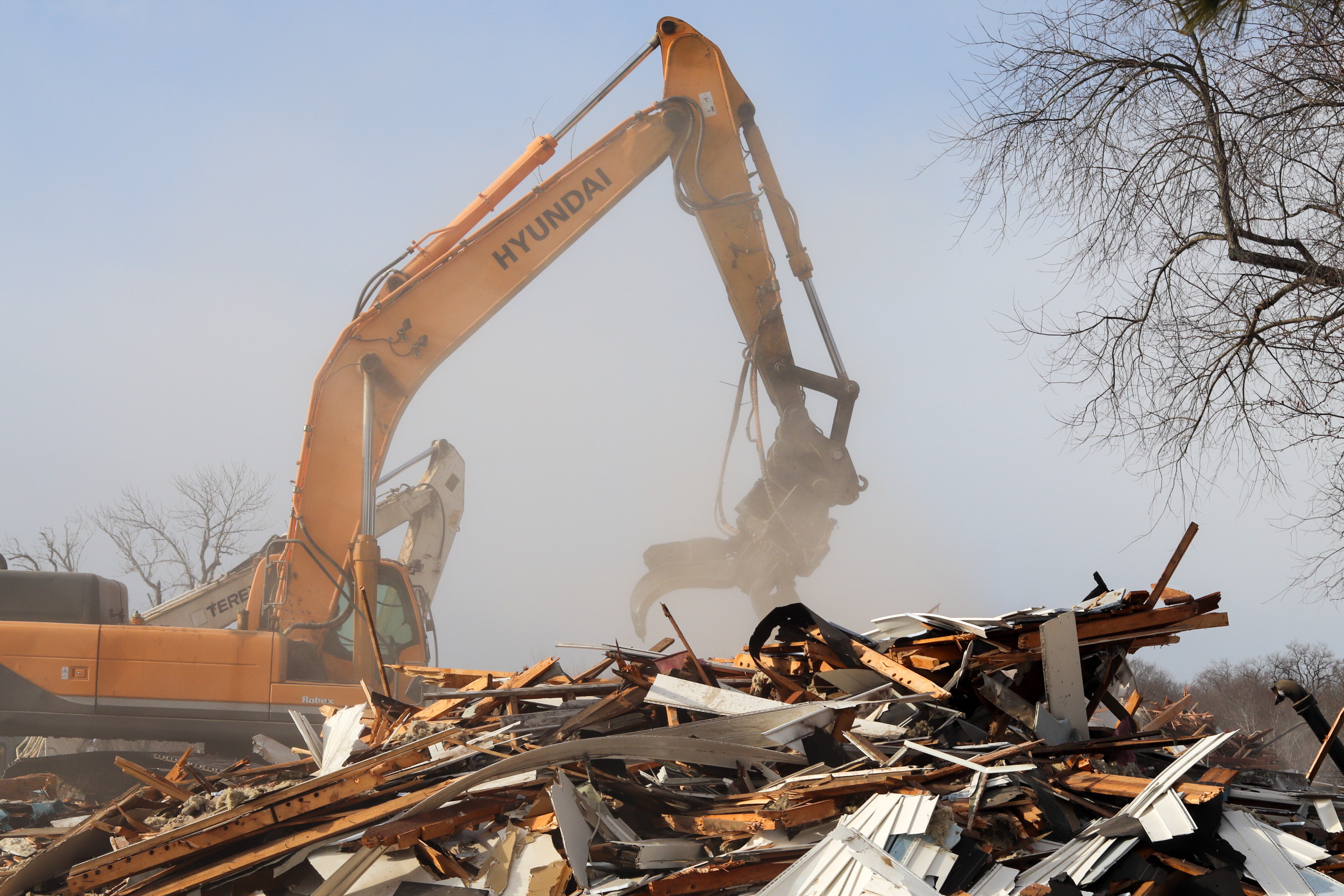
Beginning around 7 a.m. on Feb. 18, a construction crew began demolishing Crossland Hall, which is the University of Maine’s oldest building and former home of the Franco-American Centre. Students and those affiliated with the Centre who planned to attend had been told the demolition would begin at 9 a.m., based on confirmation from representatives at the Office of Facilities Management (OFM) and the construction company. When a small group arrived at that time, the demolition was already underway, leaving those present wondering why neither the University of Maine System (UMS) or OMF communicated the change in a campus-wide message.
Only a select group of community members were aware that the demolition would occur on Feb. 18, as graduate student and Save Crossland Hall movement leader Lincoln Tiner said he confirmed the 9 a.m. timing with OFM and the construction company managing the site. Many of those interviewed said they felt a lack of commitment to community transparency from the administration following the timing discrepancy. OFM has been contacted to clarify why the demolition time was moved.
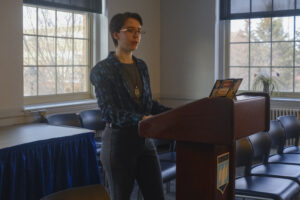
Tiner shared his reaction after hearing the demolition had begun before he could arrive.
“The feelings around not communicating properly, I mean, this is the epitome of it — us all waking up this morning, having a time we were all informed about by the company, and by Facilities, and being told this is when it would start,” said Tiner. “That is so sad that we cannot even have an honest conversation about a basic time when they’re gonna bulldoze a home for us.”
In a school-wide email sent on Jan. 29, UMaine President Joan Ferinni-Mundy expressed support for students discomforted by recent tragedies on campus — from the disappearance of former UMaine student Chance Lauer to the deaths of several students. Ferinni-Mundy also noted the impact of the impending removal of Crossland Hall, sharing that the “university remains deeply committed to the Centre and to preserving and further promoting Maine’s rich Franco-American heritage and lived experiences.”
Second year psychology student Ellie Nichols, who stopped by the demolition site while walking, commented on her reaction when reading the email.
“It was like, yes, a couple students have died in the past two weeks, and that’s upsetting, so here’s a link to our Counseling Center that’s overbooked. And then, also, [it said] I know you guys are scared to come to school, because ICE might be on campus — but also, we’re not doing anything about it. And also, just thrown in at the bottom, [they said] I know a lot of you guys are upset that we’re tearing down your building.”
The school-wide email from Ferinni-Mundy was issued just a day after the OFM ‘Crossland Removal Fact Sheet’ website was last updated, and leading up to the morning of Crossland Hall’s removal, no information was added pertaining to the demolition. However, the website does mention that the reconstruction timeline listed is “subject to change as design and construction timelines are not finalized.”
Originally, the website was created to address feedback OFM and UMS received regarding a lack of transparency, which is an issue that led the UMaine Student Government (UMSG) to pass a Dec. 9 resolution to encourage the delay of the demolition until after public commentary could be heard by the UMS Board of Trustees (BoT).
According to UMSG President Keegan Tripp, he was generally aware that “stage 2 of the Morse project” would move forward, but only learned the night before the demolition from a representative report delivered to the student Senate that it would occur on the morning of Feb. 18. Further, Tripp wrote in an email that he is unsure what communication protocol is typical of a building demolition on campus, but the failure to notify the community is “consistent with the status quo of communication on this campus that UMSG is working to improve.”
Asked if he is worried about potential consequences when community members realize the building was torn down, only after the fact, Tripp promised to address a pattern of delayed administrative communication before his term ends.
“I am certainly concerned that folks will be once again disillusioned by the whole thing. I think the major morale killer recently has been the unwillingness to change how things are communicated in advance, and I will work to see this addressed through the end of my term,” said Tripp. “At the very least, residents of nearby halls should have been informed.”
The BoT meeting that followed UMSG’s resolution occurred on Jan. 26, and despite public commentary, including from Sen. Troy Jackson and a representative of former Gov. Paul LePage speaking in opposition, the BoT decided to move forward with the demolition, citing a number of reasons also listed on the fact sheet website — including $10 million in deferred building maintenance costs and the addition of 200 parking spots in the north campus area to address an ongoing shortage.
However, PhD history student and graduate student Derek DeMello, along with others on site, indicated that these numbers cited by the university seem unconvincing, and that the need for parking does not precede the need to preserve history.
“It’s the oldest building on campus, built in 1833, [so] it predates the campus. And just demolished for parking is appalling. I’ve also yet to have seen any plans or justification for their claims that they’re going to get 200 parking spots out of this small plot of land,” said DeMello.
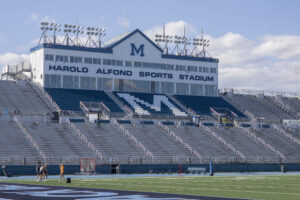
In a Feb. 3 executive summary issued by Director of Space & Capital Management Services Ryan Ward, it’s noted that 200 parking spaces will be generated through ongoing construction projects on the north side of campus — but this figure accounts for 50 spots at a new parking lot near Alfond Stadium opening in Dec. 2026 and an unspecified number of spots opening after the Dunn and Corbett lots are combined into one larger lot.
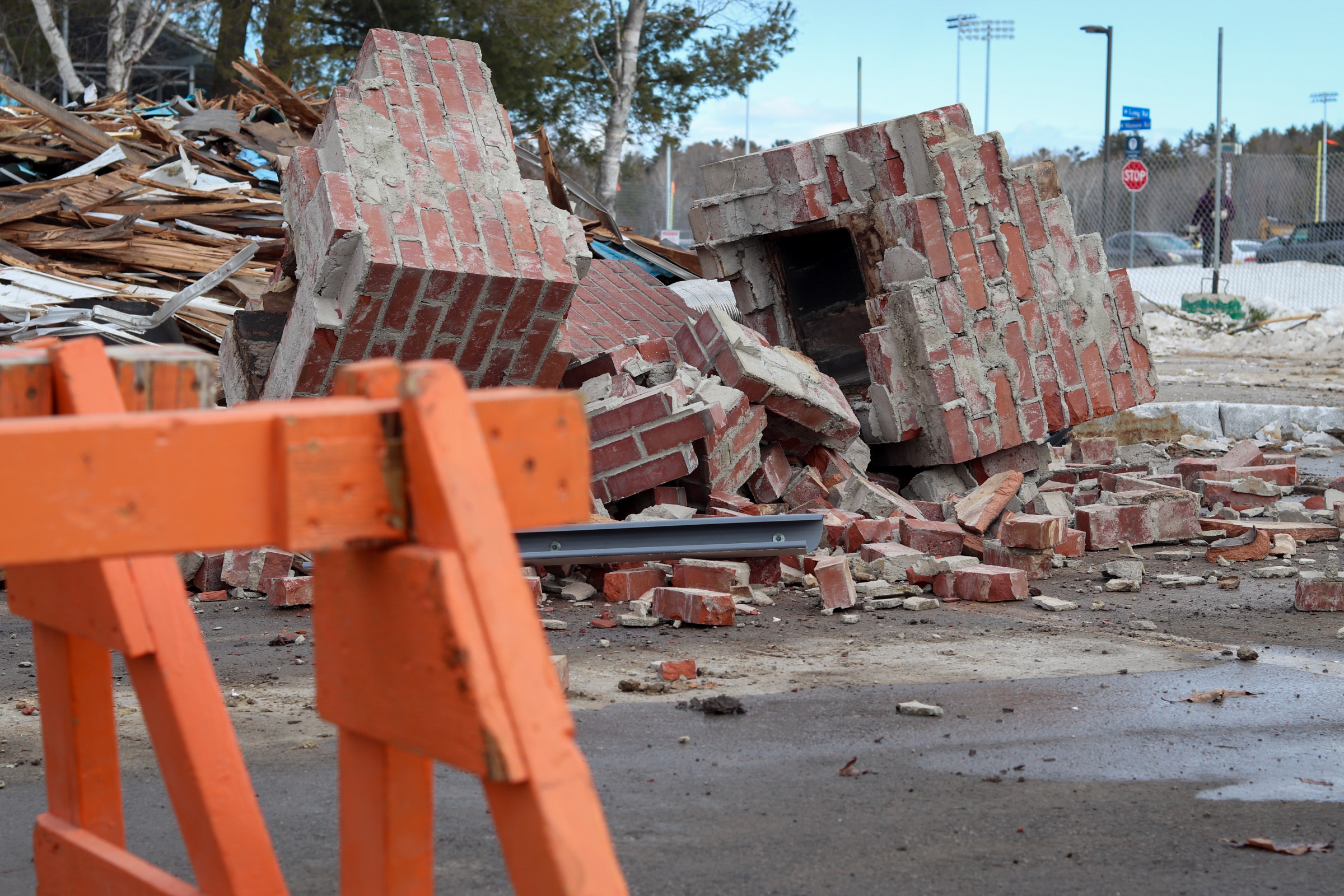
Following the demolition, Franco-American Centre volunteer Deborah E. Roberge explained how the events of the day impacted Centre community members in an interview at Libby Hall, where the Centre will remain until renovations at the Environmental Sciences Laboratory building conclude in either the fall or spring semester of next year. Roberge described watching the demolition after working for over a decade in the space, saying it was “heart breaking” to witness.
Just days prior, Roberge provided a tour of the temporary space for the Centre at Libby Hall. She identified a number of ongoing issues impacting accessibility and comfortability in the space — including repeated water leaks in the kitchen, inaccessible toilet heights for handicapped individuals and a lack of equipment to cook on hot plates given there is no oven.
With the 193-year-old structure now demolished, questions about communication protocols and how the university plans to rebuild trust with affected community members remain unresolved. UMS has yet to respond to a request for comment and updates will be provided as they become available.
Update: UMS Chief External and Governmental Affairs Officer Samantha Warren told the Maine Campus following publication that the time and date of the demolition was not broadly communicated due to public safety concerns and to minimize disruption on site. She clarified that OFM had not responded to outreach because this topic falls under her purview.