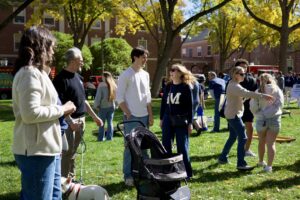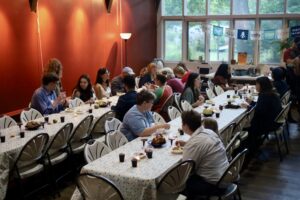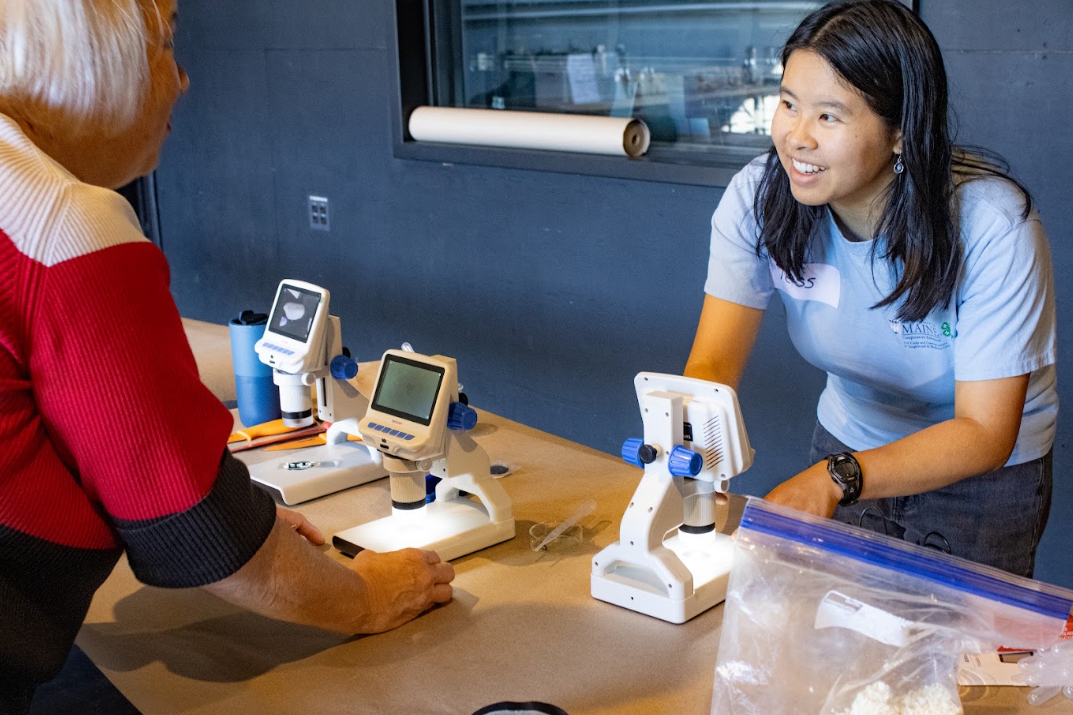
On Saturday, Oct. 3rd, the Innovative Media Research and Commercialization Center (IMRC) was full of family, friends and students walking through numerous showcases about the power of fermentation. A SCOBY petting zoo for the kids, hydrophones playing the sounds of fermentation, make-your-own sauerkraut, tie-dying with fermented indigo— the idea that fermentation is only for an improved taste was proven wrong.
“I wanted to bring people together and build community,” said Ellie Markovitch, a communications and journalism professor at the University of Maine and the founder of the food and media lab known as Fermentation Friday. Commenting on its beginnings, Markovitch said she has “a passion for storytelling and food is a great way to bring people in.”
There was no shortage of storytelling on Saturday either. Bringing together the most fermentation-forward individuals they could wrangle, those behind the tables gave the history of their practice and the food to be consumed to the attendees of the event.
“It made me think, ‘How did this start?’ like the practice of fermentation,” said Josie Veilleux, a fourth-year student at UMaine and a fermentation novice.
“Seeing solutions to waste with the fish sauce was also really inspiring,” said Veilleux. He emphasized the dimensions of fermentation which are not as visible to the average shopper. We seem to stop our conception of fermentation at pickles and onions, but attendee Liam Fischer brought his fish and eel sauce, which are made entirely from material that is otherwise trashed.
“I was convinced to try whipped cream with eel sauce and it turned out to be the best,” Veilleux laughed.
“I had fermented once before at the Terrell house and it stunk up my dorm for a while,” attendee Shannon Macdonald added. “It really breaks down the fast-paced mindset of a lot of modern things. It’s the quality of taste over the speed and quantity.” Macdonald was exposed to the nuances of fermentation via the exposition.
“My thesis started with the question: How can I represent archaic Indigenous practices in a way that Western audiences can have some understanding?” explained Alicia Bell, a master’s student at UMaine working with fermentation to answer just that. An entire room was dedicated to Bell’s display. On the table in the center were three jars of fermenting foods, one with a hydrophone inside, and the walls were covered in microscopic photos of the fermentation process.
“It’s really made me think about how every system has a process of fermentation,” Bell said about her research. “For instance the Earth has the ocean. It is always changing and exchanging with the life inside of it— if you’ve ever gone in the ocean, you’ve been fermented!”
In the back of the IMRC, children ran around with indigo-blued hands, with the smell of the dye infecting the room. Families wandered around, watching, and a clothesline of finished crafts hangs in the center of the room.
“It is just a very giving community and students really appreciate having the time to come together to grow, skill-share, ferment, try new things and document it all,” Markovitch reflected on the student response to Fermentation Friday. “We have brought guest speakers, local businesses; we have taken students on road trips, [and] we’ve presented at the Fermentation Fair. So, we just keep going and keep doing more and more.”