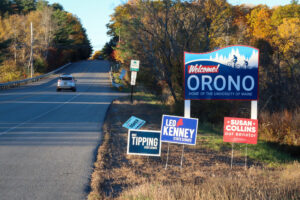
Ahead of the Nov. 3 midterm elections, the Maine Campus asked members of the University of Maine community to share their outcome predictions, particularly for Maine’s closely watched U.S. Senate race.
The election between incumbent Republican Sen. Susan Collins and Democratic challenger Troy Jackson has drawn national attention, including discussion surrounding Graham Platner’s suspended campaign and its potential impact on voters. Students and faculty offered their perspectives on the candidates and factors that could influence the outcome.
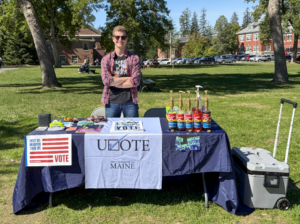
Robert Glover, an associate professor of political science and honors and co-leader of UMaine UVote, weighed in via email. He offered commentary on the effects various factors might have on the race and Mainers’ mindsets going into it, ranging from the distribution of media coverage between the candidates to the prevalence of attack ads.
“Maine is a state that tends to favor less alarmist, less extreme [and] more pragmatic political discourse. A lot of these ads are driven by large independent expenditures from entities unconnected with the campaigns. And Maine is a cheap media market. What might seem like a relatively small ad expenditure to someone from out of state saturates our airwaves for weeks. I think most Mainers are just trying to endure this and tune it out,” wrote Glover. “I hope that in the end, we’ll see voters driven to the polls by the positions of the candidates themselves, not what some out of state group is pouring into the state in advertising.”
Glover added that most Mainers had likely already decided which candidate they intended to vote for.
“This is, in part, because of the early rise of Platner. I don’t think there are too many Mainers at this point who are just totally unaware of this race. So really both campaigns are competing for a vanishingly small undecided electorate. I think this race will really come down to turnout.”
Autumn Carmona, a fourth-year botany student, said that college students may be more incentivized to vote because of the direct impact of politics on education.
“I think in college, people are a little more deeply involved because of how these issues impact them, and how it impacts their major,” said Carmona.
Carmona spoke at length about the way she felt people’s approach to the race was being shaped by social media, the campus environment and the character of each candidate’s campaign.
“I was pretty confident a month ago it was going to be Troy Jackson, and I’m still confident, but seeing the numbers recently, I’m a little surprised that he isn’t more popular,” she said. “I have a lot of hope for the movement, broadly. The transition from Platner to Jackson just shows that it’s about the movement, not the person. I think it really shows that people want real change, and they want it now.”
Amy Bradford, a fourth-year anthropology student, spoke to the Maine Campus about the transition from Platner to Jackson and her thoughts on the election.
“Maybe it’s wishful thinking, but I’m leaning towards Jackson winning just ’cause I’m hoping that people are tired of Susan Collins. I think that the fact that everyone was so gung-ho about Graham Platner before that imploded makes me think that a lot of people are ready for a change and are hopefully willing to go for the newer candidate.”
Bradford also spoke about the way she felt the scandals that plagued the Platner campaign followed Jackson’s in certain ways.
“There’s still the bad taste in people’s mouths when they remember Platner… now you see all these political ads bashing Troy Jackson by showing him with Graham Platner.”
When asked about the limited media coverage of other races, Bradford discussed how she believed it could influence voters.
“What it usually comes down to when you don’t know the candidate’s individual positions, that’s when you just go off of name recognition, ” Bradford said. “Like, Chellie Pingree, I recognize that name, so I feel like unless I do more research I might be tempted to be like, ‘oh, I’ll go with Pingree, because I recognize that name!’”
When asked about students who did not feel very well informed about the races and their candidates, Glover encouraged them to utilize resources such as VOTE411, the League of Women Voters Candidate guides, or local journalistic candidate guides.
“These are consequential races that have real implications for what our next two of four years look like,” he wrote. “And I have total faith in students to ‘do their homework’ and make an informed choice at the polls.”