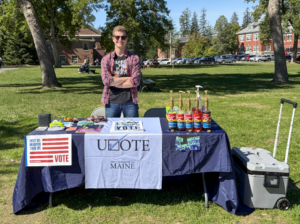
As the Nov. 3 election approaches, University of Maine students are weighing their choices in several closely watched races, including those for governor and U.S. Senate. In interviews with the Maine Campus, students expressed concerns about political influence, immigration enforcement and an increase in negative campaign advertising.
Robert Glover, an associate professor of political science and honors and co-leader of UMaine UVote, also offered his general perspective on the significance of the upcoming election via email.
“This is an incredibly important election,” wrote Glover. “We have an open seat for the Governor’s race and in the second Congressional district. And our Senate race is extremely close. Senator Collins is a uniquely powerful and well-established Senator to be facing a credible electoral challenge. Races like these could determine who controls each house in Washington. But it’s not all just D.C. politics. An individual vote can often have the greatest impact in municipal races, who is in the State House, etc.”
Glover also articulated that this election was unique relative to 2022 in that, as midterm elections reflect voters’ assessment of the president’s actions, the particular impacts that the Trump administration has had on people’s daily lives would factor into their decisions in the Congressional and Senate races.
“This race also puts Senator Collins in a challenging position. She’s always positioned herself as a moderate Republican. Opponents are trying to portray her as someone who has not been forceful enough in standing up to Donald Trump, while some Republicans would actually like to see her be more in the mold of a MAGA Republican,” wrote Glover. “I think Collins and her proximity to Trump are going to be top of mind for a lot of voters.”
The Maine Campus also interviewed Samuel Landry, a fourth-year ecology and environmental sciences student and executive officer at Alpha Tau Omega.
“Troy Jackson’s a regular working-class American, compared to Susan Collins who’s been in politics for years,” Landry said. “He has a lot more connection to the community with how he operates. He’s done a massive amount of town halls; Susan Collins hasn’t done any, to my knowledge.”
Landry emphasized his belief in the importance of separating corporate influence from the political sphere, and also said affordable housing and corruption are key issues.
“I think people taking favors for money in the Senate is absolutely abysmal and abhorrent,” said Landry. “It shouldn’t be happening. There should be no room for money in our politics.”
The Maine Campus also reached out to fourth-year ecology and environmental sciences student Gordon Young.
“I prefer Troy Jackson by virtue of him not rolling over to Trump… I don’t have a strong allegiance to him, but he’s what we’ve got,” said Young.
Young underlined his central issues for this election cycle being government transparency, as well as stronger protections for MaineCare and immigrants. When asked about reporting by New York Magazine that Jackson’s campaign had distanced itself from some grassroots supporters and a ProPublica investigation into allegations linking federal contracts and political contributions benefiting Collins, Young expressed doubts about both candidates.
“To me it just sounds like business as usual for both parties… I wasn’t aware of these accusations about Jackson, but that does check out, and it kinda makes me sad. This is behavior that I expected from Susan Collins. She’s done it before, she’ll do it again,” said Young.
When asked about Republican gubernatorial candidate Bobby Charles, both Landry and Young raised concerns about his remarks at an Aug. 20 event, where he said he planned to ask border czar Tom Homan to send Immigration and Customs Enforcement (ICE) agents and U.S. marshals to Maine polling places, according to the Bangor Daily News. Charles’ campaign said the proposal was intended to prevent illegal voting.
“It sounds like voter disenfranchisement to me,” Young said. “As far as I know, having ICE there would have no purpose considering that the average immigrant knows that they can’t vote and is gently informed as such by the people who do voter registration in Maine.”
“While I do believe illegal immigration is a problem, the solution is not getting rid of every immigrant in Maine,” Landry said. “Immigrants have built America and they continue to do so to this day. We shouldn’t have masked agents in the street who can operate with impunity with their actions, and I don’t think we need any more of that in Maine.”
The frequency and intensity of negative political advertisements was also a concern Young raised. He said that the high influx of negative ads surrounding each candidate had negatively influenced his view of all candidates.
“The content attacking each other instead of actually talking about the problems you want to take care of irks me,” Young said.