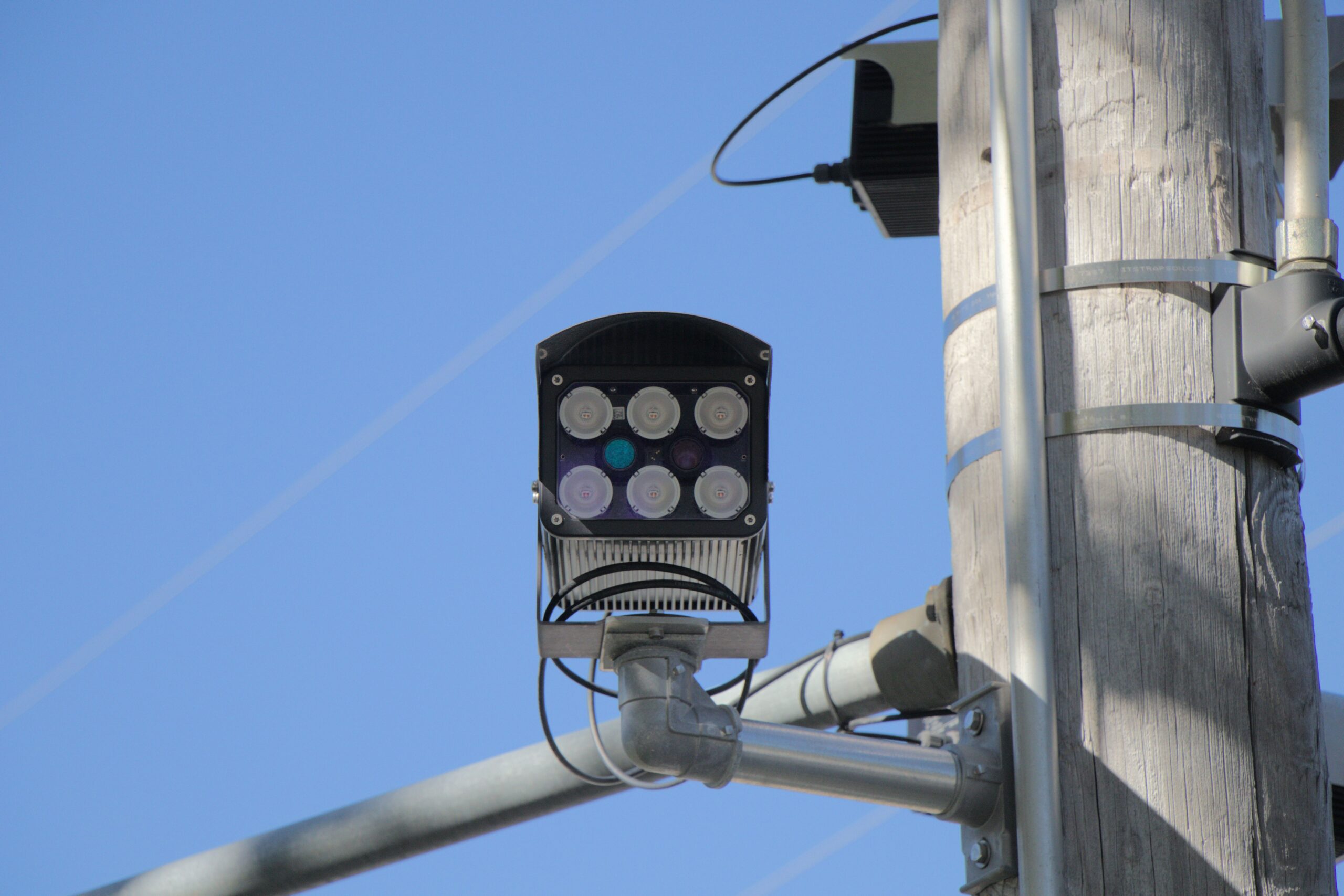
Debates on the privacy concerns and potential benefits of the automatic license plate readers (ALPR) known as Flock cameras have made their way to Old Town, and a preemptive ban is being considered. ALPRs were designed to automatically read a passing vehicle’s license plate number. Flock cameras are a form of ALPR that store information obtained from a vehicle’s license plate in a database that is accessible to police, neighborhoods and businesses.
According to the Flock Camera Locations map, there are currently 62 Flock cameras in Maine, 15 of which are located right in the Bangor, Brewer and Veazie area.
Flock cameras are praised for solving crimes such as finding missing vehicles and easing public safety concerns, but raise a broader concern to the public about their lack of consent when these cameras are in use in their area. These mass debates have led several cities and towns to not renew their contracts with Flock Safety.
Lieutenant Noel Santiago from the University of Maine Police Department (UMPD) stated in an email that UMaine does not use data from any Flock cameras in the area.
According to a recent Bangor Daily News article, the City of Old Town is considering banning ALPRs such as Flock cameras.
Zachary Wyles, Old Town City Councilor, elaborated on the proactive legislation the town is proposing.
“Flock and similar companies absolutely expand law enforcement’s abilities to conduct investigations and enforce public safety. The question for the public is whether the potential benefits of this technology outweigh the broader consequences,” said Wyles.
Wyles explained that the potential benefits of this technology do not outweigh the consequences for him.
“Some people say, ‘Well, our phones, TVs, Meta, Ring cameras, Alexa, etc. already record us!’ Those things are consensual,” said Wyles. “You don’t get to opt out of having your vehicle’s movements recorded simply because you’re driving down a public road.”
For Wyles, the issue ultimately comes down to individual privacy.
“I don’t believe we should create a system that continuously records the movements of ordinary people who have done nothing wrong simply because that information might be useful in a future investigation. Giving up any degree of privacy or liberty in exchange for a sense of increased security would be a disservice to ourselves,” said Wyles.
As Old Town continues to have discussions about the potential future with Flock cameras, University of Maine students have also raised questions about whether the potential public safety benefits are worth the privacy concerns.
Ted Forcier, a third-year communications and political sciences student, acknowledged the potential benefits of having such surveillance in the area, but also understood the debate surrounding it.
“I think that a ban is the best course of action for preserving privacy and preventing misuse. Personally, it seems like Flock cameras are the first step towards a high-surveillance state, and I doubt the average Old Town or Orono resident wants to see that,” said Forcier.
Kaylee Whalen, a fourth-year business management student, also contributed her opinion.
“Hypothetically, I think Flock cameras could be a tool for improving public safety. However, Old Town is a relatively small community, so I question whether having this level of surveillance is really needed. I would be more concerned about privacy and how the information collected could be used or stored,” said Whalen.
It is important to note that though this is currently a discussion within Penobscot County, there are currently no existing Flock cameras in the Town of Orono or the city of Old Town.