The University of Maine announced a voluntary Special Retirement Incentive (SRI) on Thursday, Nov. 5, for 158 eligible faculty members as part of ongoing efforts to address a projected $19 million budget deficit for fiscal year 2028. Faculty who choose to participate will receive a one-time payment equal to 100% of their annual base salary upon retirement on Sept. 1, 2027. A University of Maine System (UMS) official and the UMaine Faculty Senate president provided statements to the Maine Campus about the retirement incentive.
The announcement came in a letter to university employees signed by UMaine President Joan Ferrini-Mundy, Executive Vice President for Academic Affairs and Provost Gabriel Paquette and Vice President for Human Resources Nicole Lawrence.
According to the letter, faculty members at UMaine and its regional campus in Machias are eligible if “they are at least 55 years old and have at least 10 years of full-time equivalent service” as of Nov. 1, 2026. Faculty who are participating in a Partial Phased Retirement Plan will receive a prorated payment. The letter does not specify whether the university plans to replace retiring faculty members or leave their positions vacant.
UMS committed up to $6 million in one-time funding to support the incentive, with a portion of that funding also available for a SRI program at UMaine Farmington.
This new incentive was approved by the Associated Faculties of the University of Maine (AFUM), which is a union representing faculty members. According to the letter, represented and nonrepresented faculty members were notified of their eligibility earlier this week.
In a Nov. 6 written statement to the Maine Campus, UMS Chief External and Governmental Affairs Officer Samantha Warren confirmed that eligible faculty have until Jan. 2, 2027, to decide whether to participate. Warren stated that the number of faculty who accept the incentive, along with “resulting budgetary impacts for FY28 and future years” will remain unknown until after the deadline.
Warren added that “student affordability and State appropriations that have not kept pace with rising operating costs,” has resulted in “financial and enrollment pressures across Maine’s public universities.” She wrote that these pressures, attributed in part to “changes in federal funding and policy” is not a challenge unique to UMaine — citing similar budget deficit issues at schools like the University of Minnesota and the University of Oregon.
Participation in the SRI program is voluntary. The UMaine President’s Office stated this is “a deeply personal decision” for the 158 contacted individuals and that “no faculty member will be treated differently because of the choice they make.”
The move follows months of concerns over potential faculty and staff reductions at UMaine. On Sept. 17, the UMaine President’s Office announced plans to address the projected $19 million budget gap through measures that could include faculty retrenchments and staff layoffs. That initial proposal called for $10 million in reductions to Academic Affairs expenses, including the elimination of vacant positions and potential cuts to academic programs.
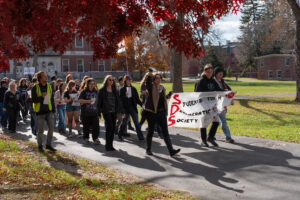
UMaine United, a coalition of university unions and organizations, responded by holding an emergency town hall on Oct. 26 to oppose the proposed cuts. Faculty, staff, students and state lawmakers spoke about the potential effects on academic programs and student services.
At the meeting, UMaine Faculty Senate President Brian McGill criticized the administration’s lack of shared governance in addressing the budget deficit.
“How’d we get here, where are we going, what are the consequences of these cuts and what’s the impact gonna be?” asked McGill. “We’re taxpayers and this is a public institution and every single taxpayer has the right to know this information.”
In a Nov. 6 written statement to the Maine Campus, McGill said he does not expect many eligible faculty members to accept the retirement incentive, citing the lack of continued health insurance coverage.
”I do not anticipate a high acceptance rate. There is no bridge for health insurance — so you basically have to be 65 and qualify for Medicare or be married to somebody who gets insurance,” wrote McGill.
Democratic state Rep. Amy Roeder, who represents House District 23 and is an adjunct theater professor at UMaine, raised the question of the budget deficit’s impact on students at the Oct. 26 emergency town hall.
“I have a question about these proposed cuts. What exactly are students supposed to get less of? Less feedback on their work, less help finding the courses they need to graduate, longer waits for counseling, fewer people answering their financial aid questions?” said Roeder.
According to the UMaine President’s Office letter, university officials will work with academic and administrative leaders to “plan for continuity in teaching, research, student support, university operations and service to the state.”
UMaine’s fiscal year 2028 budget proposal is due to the University of Maine System in late January 2027. According to Warren, the UMS Board of Trustees will review the proposal and provide “multiple opportunities for public input before a final vote in May.”
Additional budget updates will be provided as more information becomes available. Budget materials, previous presentations and a form for submitting suggestions are available on the UMaine president’s website.
This story is developing and updates will be provided as they become available. Email news@mainecampus.com with any relevant information.