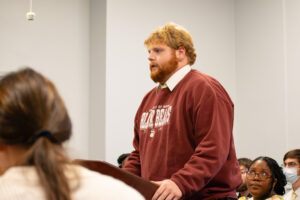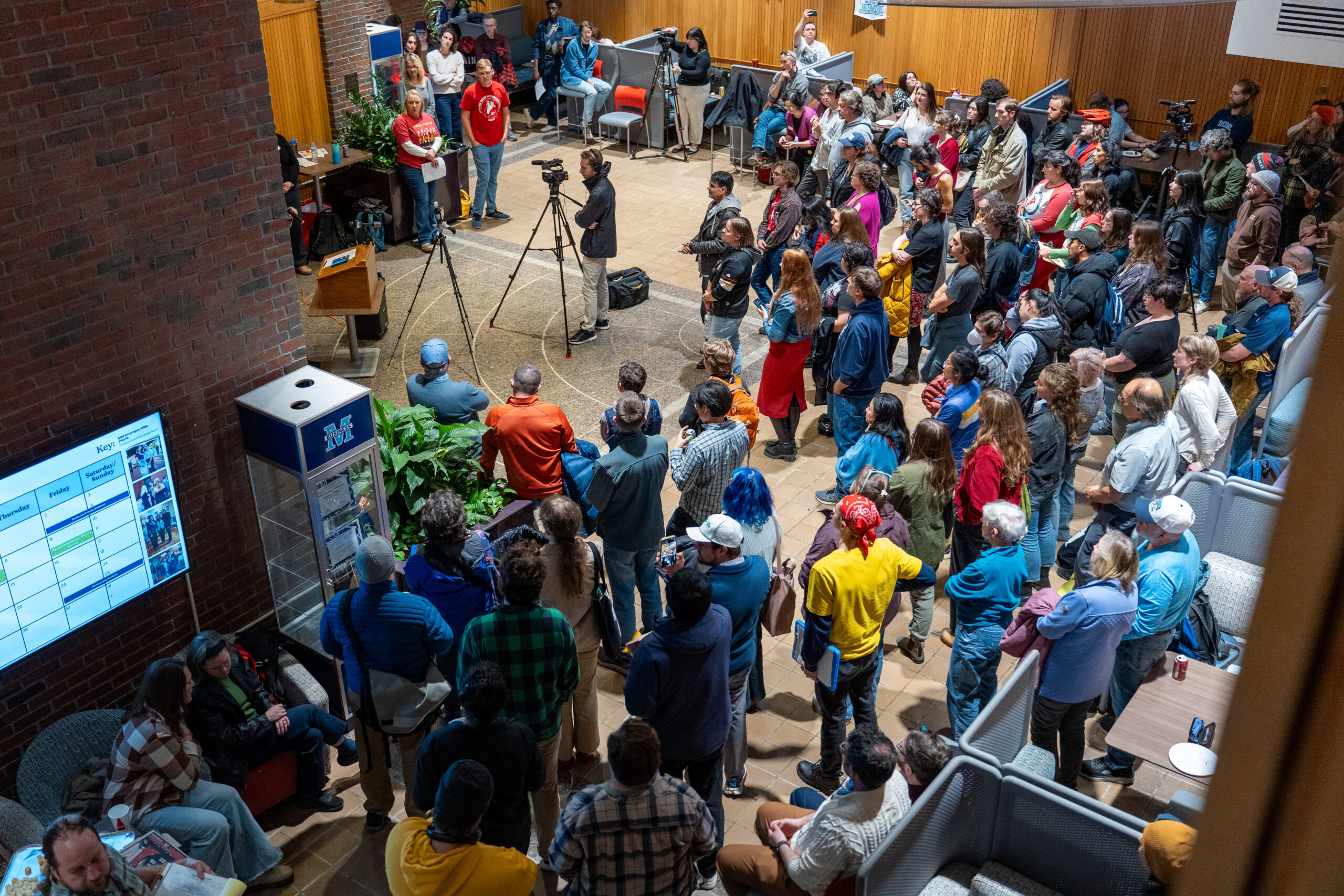
On Monday, Oct. 26, UMaine United, a group of University of Maine unions and organizations, hosted an emergency town hall meeting in the Donald P. Corbett Business Atrium to protest proposed staff and faculty cuts. The event featured eight speakers and two emcees as well as a mixer after speeches concluded. The hosts also encouraged attendees to sign a petition demanding that administrators pause any planned layoffs.
The town hall came after UMaine administrators announced a projected $19 million budget deficit that may result in staff and faculty layoffs. On Oct. 21, administrators released a letter detailing their plans for resolving the deficit, including reducing the unaccounted-for $9 million gap to $3 million. However, these plans still rely on staff retrenchments, albeit the elimination of vacant positions.
Speakers at the town hall included graduate and undergraduate students, legislators, professors and union representatives.
Democratic state Rep. Amy Roeder, who represents House District 23 and is an adjunct theater professor at UMaine, raised the question of the budget deficit’s impact on students.
“I have a question about these proposed cuts. What exactly are students supposed to get less of? Less feedback on their work, less help finding the courses they need to graduate, longer waits for counseling, fewer people answering their financial aid questions?” said Roeder. “You cannot reduce the people available to students and promise students a credible education.”
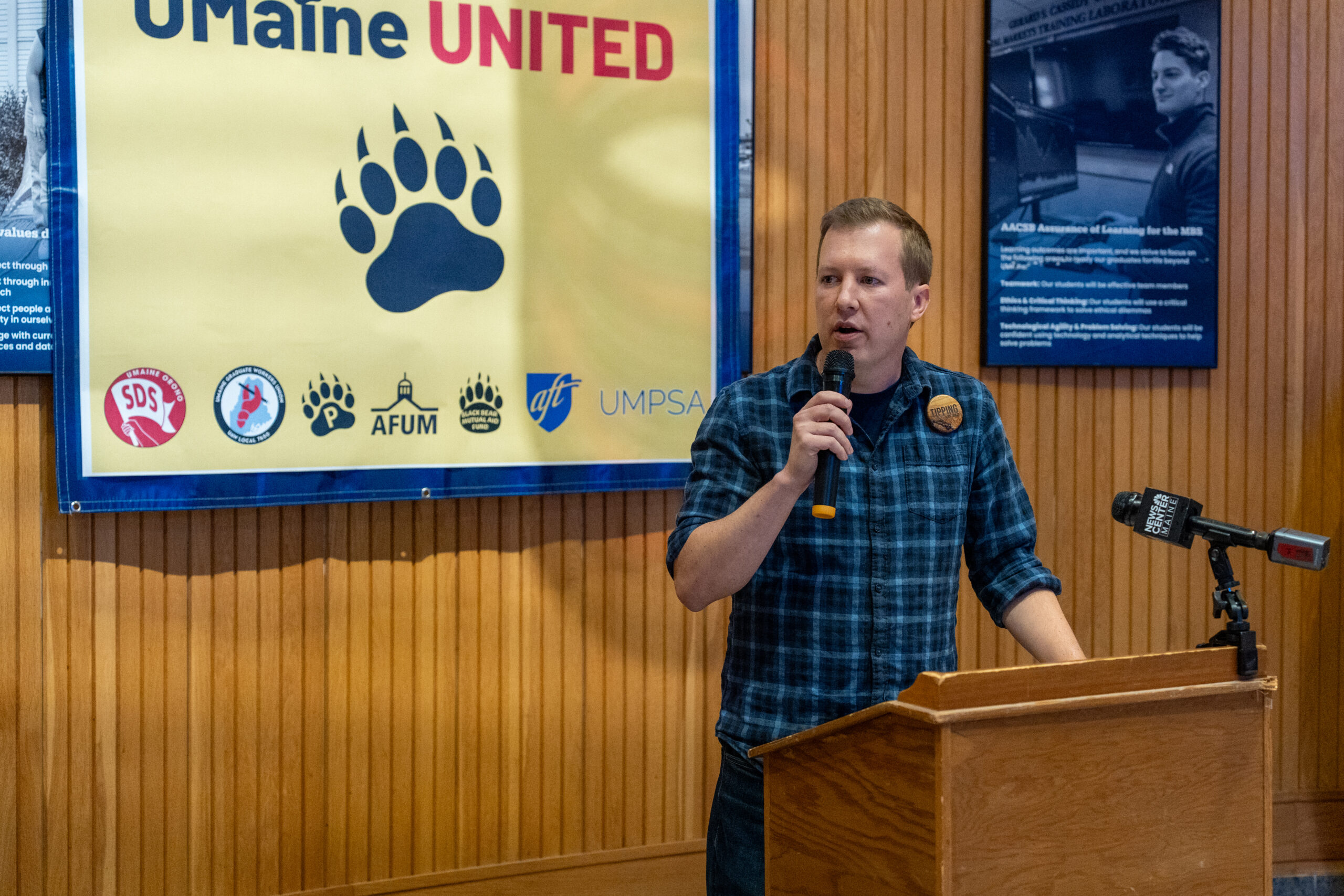
Democratic state Sen. Mike Tipping, who represents Senate District 8 and is up for reelection in November, stated that students and community members have power as a significant source of university funding.
“You pay a majority of the costs, you should have a majority of the say,” said Tipping.
He added that the state has been “systematically underfunding” public education for decades, and advised the community not to “take these cuts lying down.”
Lisa Neuman, the president of Orono’s chapter of the Associated Faculties of the Universities of Maine (AFUM), highlighted the importance of retaining faculty, especially following the 17% loss in 2022.
“We cannot cut our faculty by 10%,” said Neuman. She also asserted that there was not enough available data to support administrators’ decision to initiate layoffs.
Brian McGill, president of the UMaine Faculty Senate, pointed out that there had been a distinct lack of shared governance in the way university administration had been handling the budget deficit.
“How’d we get here, where are we going, what are the consequences of these cuts and what’s the impact gonna be?” asked McGill. “We’re taxpayers and this is a public institution and every single taxpayer has the right to know this information.”
Sara Abronze, the statewide president of the UMaine Professional Staff Association (UMPSA), demanded a full review of administrative costs and called for increased transparency.
“This issue should have been discussed with our labor unions first,” said Abronze. “We are being starved of the resources required to fulfill our mission [as an R1 university].”
She added that since every dollar spent on the university generates about $4 dollars in economic revenue, the university community “will not accept layoffs as a solution to state neglect.”
Jacquelyn Gill, a professor of paleoecology and plant ecology and one of the event’s emcees, offered her perspective as a faculty member.
“Our staff have been cut and cut and cut to the bone, and asked to do more things,” said Gill. She added, “I don’t know which of my colleagues are still going to be here next spring, next fall.”
Mo Drammeh, an undergraduate student, stressed the importance of faculty on the university’s credibility and what stance other students were likely to take.
“As it would turn out, students… side with their teachers,” said Drammeh.
The crowd began chanting “stop the cuts” of their own volition after the conclusion of Drammeh’s speech.
Andrii Obertas, a member of the UMaine Grad Workers Union (UMGWU), highlighted the importance of collaboration.
“An injury to one person is an injury to all,” said Obertas.
Aurora Green, president of UMGWU and the event’s second emcee, initiated “UMaine united” chants and emphasized the importance of fighting for the university.
Maeve Durkee, an undergraduate student, demanded that administrators look at administrative overhead and consider how these changes would affect students.
“I’m worried that the classes I’m gonna register for this week won’t actually be available next semester,” said Durkee.
She also mentioned the university’s contract with OpenAI, which was met with boos from the crowd.
“Administration has spent $1 million on an AI program that no one I know has actually used,” she said.
Event organizers plan to meet on the steps of Fogler Library at 9:30 a.m. on Oct. 29 to deliver their petition to the office of President Joan Ferrini-Mundy in Alumni Hall.