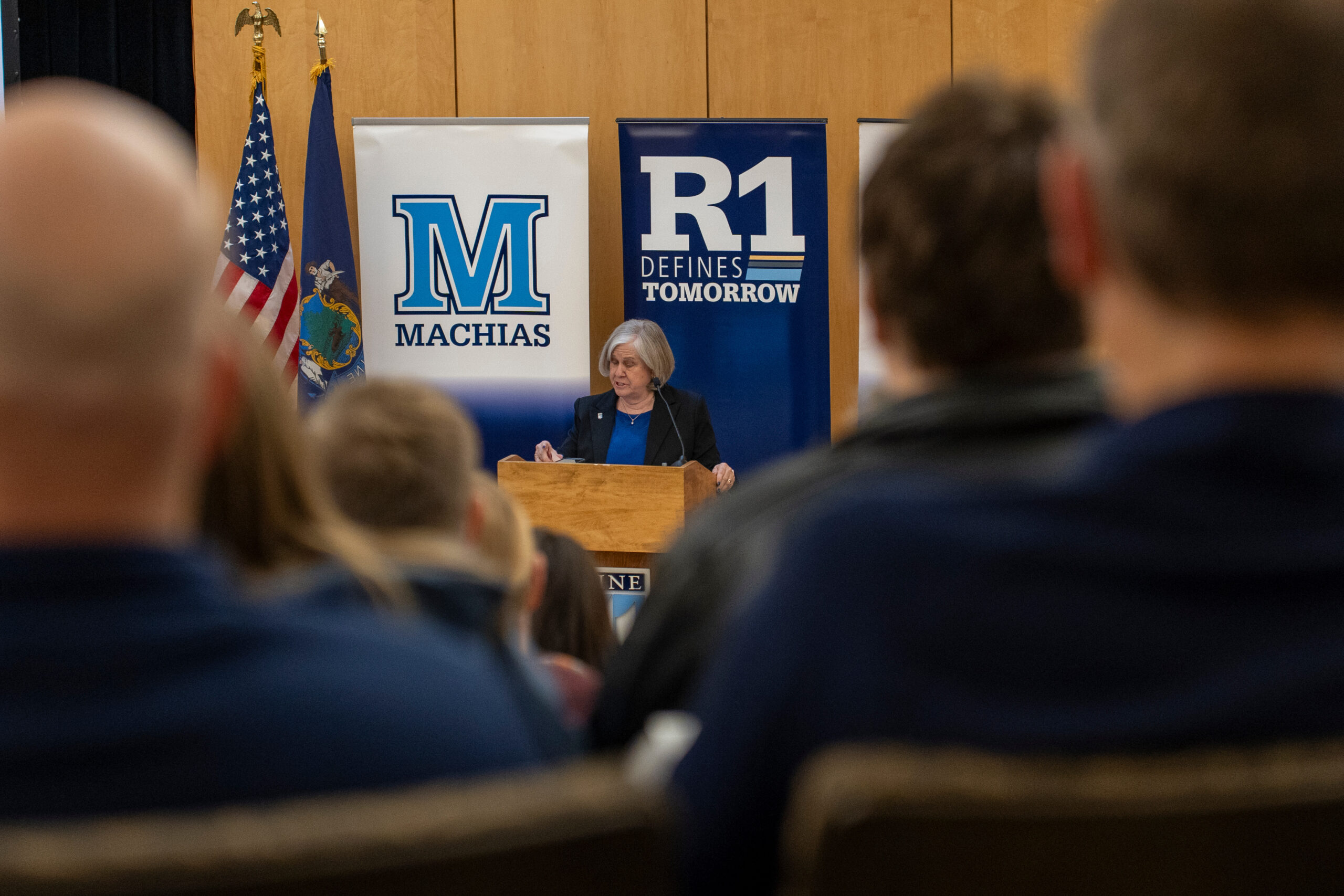
University of Maine President Joan Ferrini-Mundy delivered the annual 2026 State of the University Address on March 4 to a full audience in Minsky Recital Hall. Ferrini-Mundy has delivered the address since she became the 21st president of UMaine in July 2018, and this time focused on topics such as the administrative response to federal funding challenges, the UMaine System’s (UMS) recently ratified graduate workers union contract and future budget-balancing plans linked to UMaine’s development through its Strategic Re-Envisioning plan (SRE).
Chancellor Daniel Malloy began with brief remarks before introducing Ferrini-Mundy. After touching on the war in Iran and the loss of human life, Malloy honed in on how UMaine has navigated its relationship with the federal government.
Last February, the university’s Title IX office underwent a temporary funding pause and review by the U.S. Department of Agriculture (USDA) tied to a federal executive order on transgender athletes’ participation in women’s sports. While the USDA found UMS to be in compliance just weeks later, the potential revocation of federal funding spawned concerns about program funding stability at the university level.
“Unusual things [are] happening in the federal government, decisions being announced, monies being taken away, sometimes coming back [and] sometimes never to be seen again,” said Malloy.
Malloy touched on the leadership position UMaine’s flagship campus has taken in facilitating conversations to navigate federal funding challenges among private and public universities in New England. Finally, Malloy raised the point that UMS ratified their contract with the UMaine Graduate Workers Union (UMGW) in Dec. 2025, after more than 700 days of bargaining. He specified how the $750 bonus paid to 900 part-time graduate student workers would be paid in a way that avoids depleting funds allocated for research.
“Rather than having that money taken out of dollars appropriated for actual research, the system will step in and make those payments,” said Malloy.
Ferrini-Mundy then took to the stage. She began by sharing she believes “the state of this university is strong and it is evolving” — with UMaine serving as “the most powerful educational and economic development engine in the state” and having formed strong ties to Maine companies that are “actively partnering with us to develop solutions that they need to thrive.”
Ferrini-Mundy then led a moment of silence to acknowledge the deaths of two UMaine students and disappearance of former student Chance Lauer. She also acknowledged the unique pressures that face UMaine’s international community in wake of recent federal immigration policies.
“I hope that a part of the reason all of us are here is because it feels like home, because it feels safe [and] because it nurtures and challenges us. I truly hope that is true of our 490 international students, faculty and staff from the 67 countries they represent.”
She highlighted cultural events and achievements on campus, including partnerships with the state of Maine, like Dr. Angela Mech’s research on Spruce Budworm populations. She then mentioned the growth of certain initiatives, such as UMaine’s cooperative extension program, which reached “over 72,000 individuals” this past year.
Shifting toward current challenges, Ferrini-Mundy commented on the current fiscal situation, which includes inconsistent federal funding allowances and $1.1 billion in deferred maintenance costs on a campus with ever-aging infrastructure. She cited credit hours being down 4% from budgeted projections, despite overall enrollment in graduate and postgraduate programs increasing. She also said out-of-state enrollment has dropped.
Referencing UMaine’s historical budget constraints during times like the Great Depression or recessions, and the university’s previous recovery efforts, she said that they embraced “strategic planning to align resources with their mission, not unlike our ongoing SRE efforts.”
She emphasized the university’s resilience in responding to budgetary concerns, embracing an SRE plan that has produced “an extraordinary set of next steps and outcomes.” Projects under the SRE umbrella are numerous, but some efforts include the university’s capital and facilities investment plans, improvements to the admissions process and the formation of specialized advisory boards to aid in budget restructuring efforts.
Outside budgetary efforts, she mentioned other positive outcomes generated through the SRE to realign resources — including the effort to “responsibly integrate AI” and continuing the “most expansive campus construction and renovation in decades.” She also suggested these efforts have contributed to the retention of jobs at UMaine, despite national trends where “over 9,000 higher jobs were cut in 2025, across the country, tied to budget pressure.” Of those jobs, she reports that “very few” were cut at UMaine.
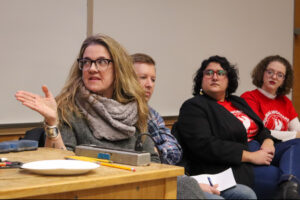
Despite emphasis on effective responses when navigating federal challenges, about a dozen students were in attendance with signs protesting a perceived lack of willingness to ensure protections for the international students on campus. In an interview following the speech, several described their choice to hold signs calling for the passage of SM 2106. Over the past several months, student-led political groups on campus have spearheaded efforts to define clear protections for international students, following the recent detention of several UMS graduates. In Nov. 2025, the motion was passed by the Faculty Senate, and recommendations were then sent to the Office of the President.
Third-year French and history student, and UMaine Students for a Democratic Society member, Gabrielle Veilleux addressed a community-wide message regarding federal immigration policies issued on Jan. 29 by the Office of the President, which he criticized for its vague language, even if well-intentioned.
“Specifically, a lot of it [the senate motion] was pushed forward in response to information coming out of the Trump administration, and especially when the university released guidance information on ICE,” said Veilleux. “That really prompted people to start asking questions, like, where is the real policy? We saw a lot of vague statements from the university, but actual policy wasn’t really getting pushed.”
Students who were in attendance outside those protesting were also interviewed. First-year music performance student Juliannah Soper shared that she found the message to be “broad” and that the speech didn’t go into “a lot of real concerns a lot of us students are having.” Soper was asked what those concerns are.
“I wish we talked more about the budget and more specific details about the deficit, and [in] more detail, and just what are the approaches for the coming school year. [And] more about our response to ICE if they do come on campus.”
Those interested in watching a recording of the address can watch a livestream on UMaine’s YouTube channel. A full transcript of the event will also be published on the Office of the President’s website.