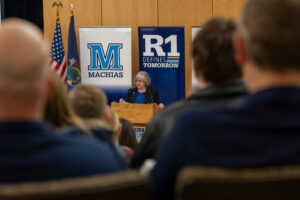
The University of Maine System (UMS) Board of Trustees’ Academic and Student Affairs Committee accepted a presidential task force’s recommendation to remove on-campus references and honors associated with former U.S. Sen. George Mitchell on Aug. 24 in response to his name appearing in the Epstein files. Nearly three-quarters of those who provided responses during the public comment requested the system cut ties. The recommendation to revoke naming rights will go before the full board for a final vote during a scheduled Sept. 27-28 meeting at the University of Maine at Presque Isle.
In a Sept. 9 written statement to the Maine Campus, UMS Chief External and Governmental Affairs Officer Samantha Warren confirmed the names that the two primary UMaine programs bearing Mitchell’s name would adopt if the task force’s recommendation is accepted by the BoT on Monday. The Senator George J. Mitchell Center for Sustainability Solutions would temporarily become the University of Maine Center for Sustainability Solutions, while the George J. Mitchell Peace Scholarship would become the University of Maine Peace Scholarship.
In February 2026, shortly following Mitchell’s resignation from the Mitchell Institute, the university confirmed that it would make a decision that best serves the “interests of our students and the state” and that the system as a whole “strongly condemns sexual violence and exploitation.” One month later, UMS Chancellor Dannel Malloy and UMaine President Joan Ferrini-Mundy formed a presidential task force to review Mitchell’s naming rights on campus. The task force gathered public comment as part of its review.
According to an April 11 report published by the task force, 54 of the 74 respondents, or 73%, “explicitly requested that the name [Mitchell] be changed, revised, or removed to avoid negative associations.” Another 11% requested that the committee “wait for more proof or a formal review of the files, warning against a rush to judgment without definitive evidence of wrongdoing.” Additionally, about 50% of the total comments cited Mitchell’s connection to the Epstein files as a primary cause for concern, using terms like “scandal,” “vile” and “unacceptable” in written feedback provided to the committee.
In its report, the task force notes that “any discussion of Senator George J. Mitchell’s public regard must begin with an acknowledgement of his previously honorable reputation.” Despite the former senator’s accomplishments — which include his prominent role in brokering the 1998 Good Friday Agreement in Northern Ireland and his founding of the Mitchell Institute, which has awarded millions of dollars in scholarship funding to Maine students — the task force ultimately recommended removing his name.
“While no findings of wrongdoing by Senator Mitchell have been made, in light of the material that has recently been made public by the US Department of Justice, and mindful of the experiences of victims and survivors, the Task Force concludes that continued use of Senator Mitchell’s name would compromise the public trust and reflect adversely upon the University and its reputation,” reads the report. It concludes by sharing that it is “no longer appropriate for the University’s institutional spaces, entities, scholarships and funds to bear his name.”
Mitchell’s association with Jeffrey Epstein became the subject of public scrutiny years before the university initiated its review. In documents unsealed in August 2019 by a New York federal court, survivor Virginia Giuffre named Mitchell as one of the high-profile people to whom she was trafficked by Epstein and Ghislaine Maxwell while she was underage. Mitchell denied having met Giuffre or having knowledge of the conduct she alleged.
Additional records concerning Mitchell and Epstein have since become public. For instance, a copy of a birthday book created for Epstein in 2003, which was released by a U.S. congressional panel in September 2025, included a handwritten letter attributed to Mitchell in which he described his friendship with Epstein as one of many “blessings” in his life.
These disclosures prompted institutions in Maine and abroad to reconsider honors bearing Mitchell’s name. Queen’s University Belfast in Ireland removed his name from an institute and took down a bust of the former senator in February. Locally, the Waterville Board of Education voted in March to remove Mitchell’s name from an elementary school. His portrait was also removed from the Maine State House’s Hall of Flags.
On Sept. 24, the Maine Campus informally polled 35 students on campus about their awareness of the upcoming BoT vote on Mitchell’s naming rights. Of the students polled, 22, or 63%, said they were unaware that the vote was five days away. After being informed of the task force’s review process and recommendation, 73% said they supported removing his name from university programs and honors. Another 21% said they needed more information before taking a position, while 6% said Mitchell’s name should not be removed.
Outside this feedback, several students at University College Cork in Ireland, which exchanges students with UMaine through the George J. Mitchell Peace Scholarship, offered their perspectives on potential name changes in March interviews with the Maine Campus. The majority supported removing Mitchell’s name from university programs, though several noted his historical contributions to the Northern Ireland peace process.
Those interested in following the board’s decision regarding Mitchell can attend the Sept. 28 meeting at 8 a.m. in the multipurpose conference room within the Campus Center on the UMaine Presque Isle campus. The meeting can also be watched through the trustees’ YouTube channel. Public comment can be provided over Zoom, with advance registration required by noon on Friday, Sept. 25.
This story is developing and updates on the board’s decision will be provided as they become available.